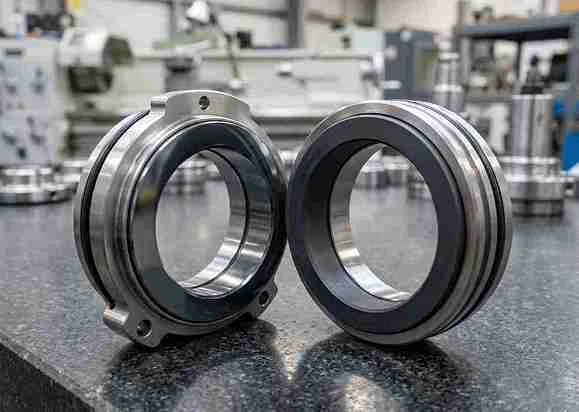
Copper Graphite Brushes Manufacturer
CARBOLVE copper graphite brushes are industrial sliding electrical contacts manufactured from copper-containing graphite material. They are not copper wire brushes or copper-plated sheets. We manufacture custom copper graphite brushes for applicable low-voltage DC motors, starter motors, traction motors, slip rings, and current-transfer systems. We evaluate custom dimensions, verified copper grades, and contact-surface data to support OEM and replacement requirements.
- Custom Copper Graphite Brush Manufacturing
- Low-Voltage and High-Current Applications
- Drawing and Sample-Based Production
- Application-Based Material Review
- OEM and Replacement Support
Send the equipment model, brush dimensions, copper grade information, contact-surface data, voltage, current, speed, operating environment, and required quantity for evaluation.
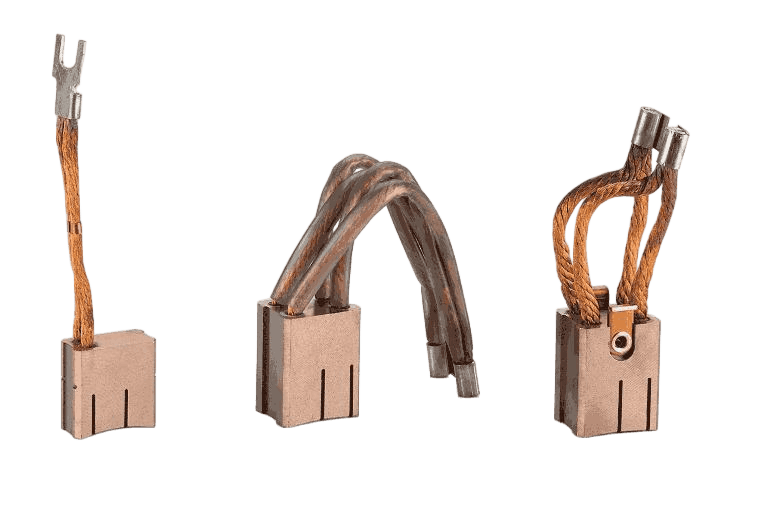
Copper Graphite Brushes for Motors and Rotating Contacts
Copper content, material route, brush dimensions, contact pressure, current, voltage, speed, contact-surface material, duty cycle, and environment must be reviewed together for optimal performance.

Copper Graphite DC Motor Brushes
- Selected low-voltage DC motors
- High-current motor applications
- Custom brush dimensions
- Commutator-specific evaluation
- OEM and replacement production

Copper Graphite Starter Motor Brushes
- Automotive or industrial starter systems
- High starting current
- Intermittent duty
- Custom lead and terminal assemblies
- Equipment-specific brush construction

Traction and Forklift Brushes
- Forklift and lift-truck motors
- Traction drives and pump motors
- Steering motors where applicable
- Start-stop and reversing conditions

Copper Graphite Slip-Ring Brushes
- Continuous rotating current transfer
- Power rings and collector rings
- Cable reels
- Industrial current-transfer systems

Generator & Collector Brushes
- Selected low-voltage generators
- Excitation or collector-ring applications
- Welding and annealing systems
- Electroplating equipment

Custom Copper Graphite Contacts
- Non-standard brush bodies
- Custom contact blocks & multiple shunts
- Custom terminals & face geometry
- Drawing-based production
Can’t Identify the Copper Graphite Brush?
What Is a Copper Graphite Brush?
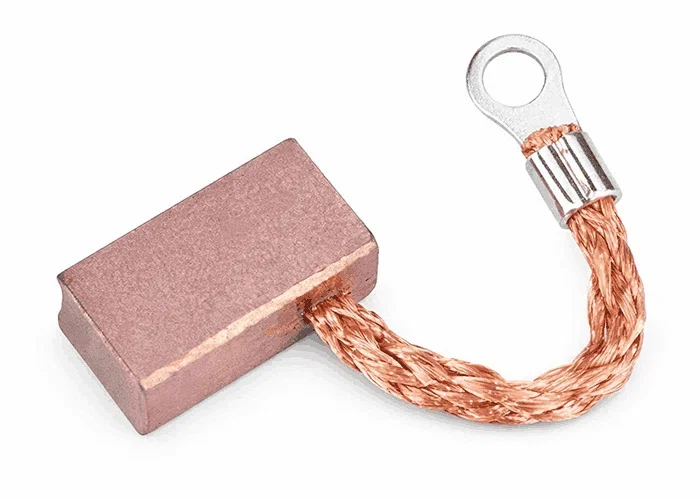
A copper graphite brush is a sliding electrical contact made from a graphite-based composite containing copper or a copper alloy. It transfers current between stationary and rotating parts through a commutator, slip ring, collector ring, or another approved electrical contact surface.
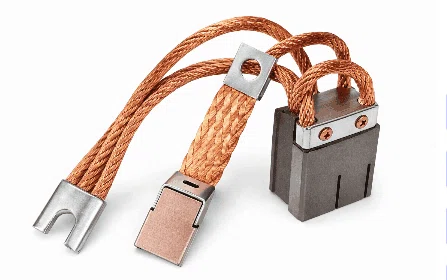
A complete product may include the copper graphite brush body, contact face, flexible copper shunt, terminal, top pad or plate, spring, cap, and mounting feature.
How Do Copper Graphite Brushes Transfer Current?
- A brush holder and spring system maintain controlled contact between the brush and a rotating electrical surface.
- Electrical current passes through the terminal and flexible shunt into the brush body.
- The brush transfers current through the sliding contact face.
- Copper provides application-specific conductivity, while the graphite phase supports sliding contact.
- The brush and rotating surface gradually wear according to the electrical, mechanical, and environmental conditions.
Actual performance depends on copper content, base graphite, material route, resistivity, dimensions, contact area, pressure, surface material, speed, voltage, continuous/peak current, duty cycle, temperature, humidity, vibration, and contamination.
How Copper Is Combined With Carbon Graphite
Copper graphite is a material family rather than one universal grade. The two primary material routes create different structures and properties.
Copper-Powder Graphite Material
Copper or copper-alloy powder is incorporated into graphite or carbon-based raw materials during preparation. Potential characteristics include:
- Higher electrical conductivity
- Lower electrical resistance
- Different contact voltage drop
- Increased density and different mechanical strength
Copper-Impregnated Carbon Graphite
Copper is introduced into the porosity of a preformed carbon or graphite base through an impregnation process. Potential effects include:
- Increased electrical conductivity
- Reduced porosity
- Changed strength and thermal behavior
- Changed dimensional and wear characteristics
Why Is Copper Graphite Used?
Potential Benefits
- High electrical conductivity and low resistivity
- Low or controlled contact voltage drop
- High current-transfer capability
- Sliding-contact behavior from the graphite phase
- Suitability for selected low-voltage, high-current systems
Every benefit is grade and application dependent.
Technical Limitations
- Unsuitable if commutator requires higher resistance for stability
- Risk of copper oxidation or chemical corrosion
- Incompatible with certain contact surfaces or high speeds
- A lower-friction electrographite material may be required
- Silver graphite may be needed for precision signals
Copper Graphite Brush Construction Options

Shuntless Brush

Single-Shunt Brush

Multiple-Shunt Brush

Multi-Section Brush

Paired Brush

Spring-Loaded Brush

Top Pad / Plate

Custom Terminals
Copper Graphite Material Properties
| Material Property | Why It Matters | CARBOLVE Data |
|---|---|---|
| Material route | Distinguishes powder-blended and impregnated structures | [Insert verified material route] |
| Copper content | Influences conductivity, density, strength, wear and cost | Available by verified grade |
| Electrical resistivity | Influences current transfer and voltage drop | Available by verified grade |
| Contact voltage drop | Important for low-voltage systems | Application dependent |
| Current-density capability | Depends on grade and contact system | Application dependent |
| Speed capability | Depends on grade, ring, pressure and environment | Application dependent |
Custom Copper Graphite Brush Specifications
| Parameter | Customization Information |
|---|---|
| Thickness & Width | Produced according to drawing, sample, or holder dimensions |
| Length | Confirm the original or unworn length where possible |
| Contact face | Flat, radiused, beveled, grooved, angled, or custom |
| Shunts | None, one, multiple, specific length and position |
| Terminal type | Confirmed from drawing or sample |

Common Copper Graphite Brush Problems
Excessive Brush Heating
Factors: Excessive current, small contact area, incorrect copper content, high resistance, damaged shunt.
CARBOLVE Response: Review current, voltage, dimensions, area, shunts, and temperature.
Excessive Voltage Drop
Factors: Incorrect material, low conductivity, ring oxidation, poor pressure, loose connection.
Note: Increasing copper content alone will not always solve the problem.
Excessive Sparking or Arcing
Factors: Material unsuitable for commutation, incorrect neutral position, damaged commutator.
Note: High conductivity alone does not guarantee good commutation.
Rapid Brush Wear
Factors: Incorrect grade, excessive pressure, rough ring, abrasive dust, high speed, vibration.
Commutator Grooving
Factors: Unsuitable material, incorrect pressure, contamination, mechanical runout.
Brush Sticking
Factors: Incorrect dimensions, rough sides, dust buildup, holder deformation, thermal expansion.
Manufacturing & Quality Control
How Brushes Are Manufactured
-
1
Material Selection: Select verified copper graphite material according to approved requirements.
-
2
Precision Machining: Machine thickness, width, length, contact face, radius, bevels, and grooves.
-
3
Shunt & Terminal Assembly: Connect flexible leads and attach approved terminals via verified methods.
-
4
Finishing & Marking: Prepare running face and apply grade, part number, or customer identification.
Quality Control Before Shipment
-
Dimensional Inspection: Check thickness, width, length, radius, and shunt positions.
-
Surface & Edge Check: Inspect for cracks, chips, rough sides, and contact-face defects.
-
Assembly Inspection: Verify shunt flexibility, terminal orientation, and multi-section matching.
-
Testing: [Insert verified CARBOLVE test capability] (e.g., resistance, shunt pull testing).
Copper Graphite Material Comparisons
Copper Graphite vs Metal Graphite
Metal graphite is the broader material category containing graphite combined with a conductive metal.
Copper graphite is a specific metal-graphite material containing copper or a copper alloy. Other metal graphites may contain silver or bronze.
Copper Graphite vs Carbon Graphite
Copper graphite generally offers higher conductivity and lower resistance, often considered for high-current transfer.
Carbon graphite provides higher resistance and different commutation/cleaning behavior. Neither is universally better.
Copper Graphite vs Electrographite
Copper graphite is generally selected for low-voltage, high-current, and slip-ring applications.
Electrographite is often selected for application-specific commutation in industrial motors. Copper graphite should not replace it solely for lower resistance.
Copper Graphite vs Silver Graphite
Copper graphite is used for motor and power-transfer applications.
Silver graphite is considered where very low resistance, sensitive signals, grounding, or corrosion behavior justifies higher cost.
Copper Graphite vs Pure Copper
Pure copper provides high conductivity but lacks graphite-based sliding-contact behavior. The choice depends on whether the part functions as a sliding brush or a stationary conductor.
Slip-Ring vs Commutator Brushes
Copper graphite is commonly considered for power-transfer slip rings. For commutators, it must be evaluated carefully according to commutation requirements, not just conductivity.
Frequently Asked Questions
Does more copper always improve brush performance?
Does CA35 or A30 automatically mean 35% or 30% copper?
What color is a copper graphite brush?
Can copper graphite brushes be used on commutators?
Can copper graphite brushes be used for grounding?
Does replacing the brush always solve an electrical problem?
How long do copper graphite brushes last?
Request a Custom Copper Graphite Brush Quote
Complete electrical, material, dimensional, and contact-system information helps CARBOLVE evaluate the material direction, brush construction, and quotation details.