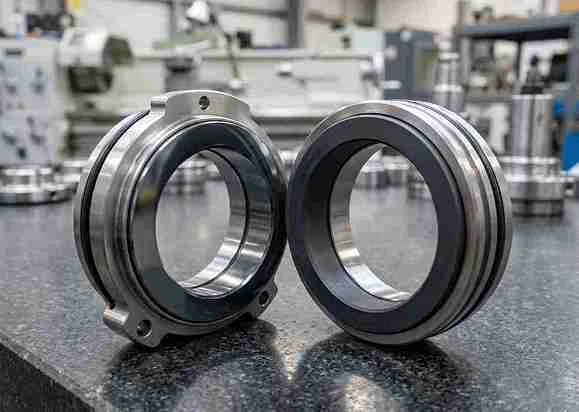
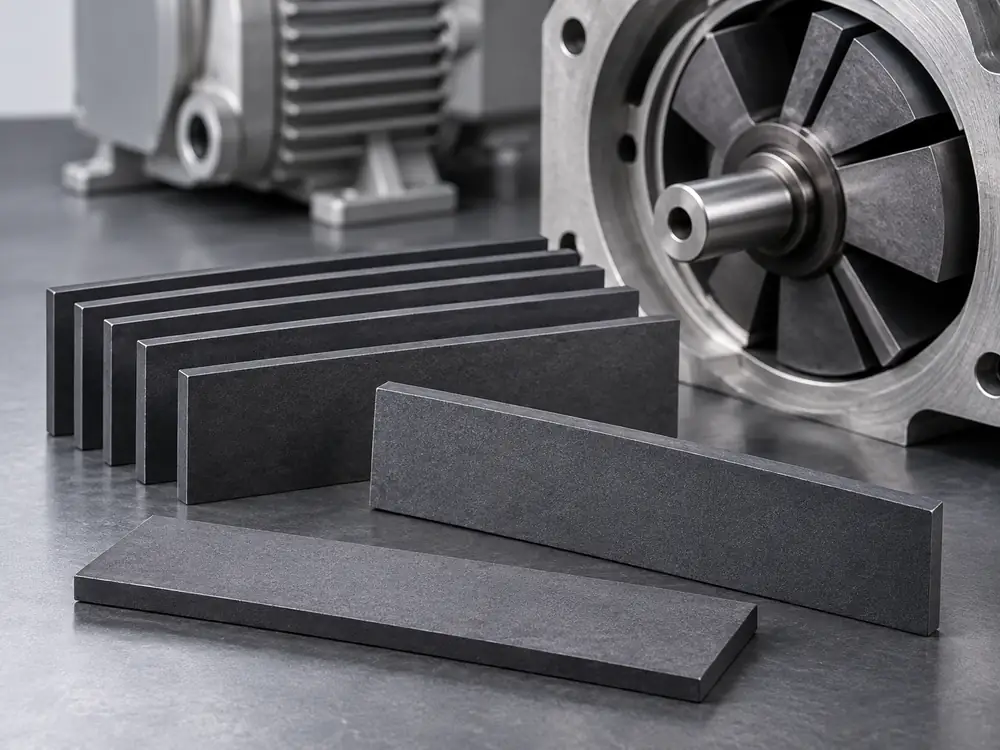
Milking Machine Vacuum Pump Vanes
CARBOLVE manufactures carbon graphite and custom composite vanes for replacement projects involving selected rotary vane pumps in milking equipment. Dry-running and oil-lubricated options are reviewed against the pump model, original material and complete vane geometry.
- Carbon graphite and selected composite constructions
- Drawing-based dimensions and edge profiles
- Replacement identification and custom manufacturing
Components for vacuum generation—not milk-transfer pump parts.
Start with the Pump’s Lubrication Type
The milking machine name alone does not identify its replacement vanes. Pump versions, materials and dimensions may differ even within the same equipment family.
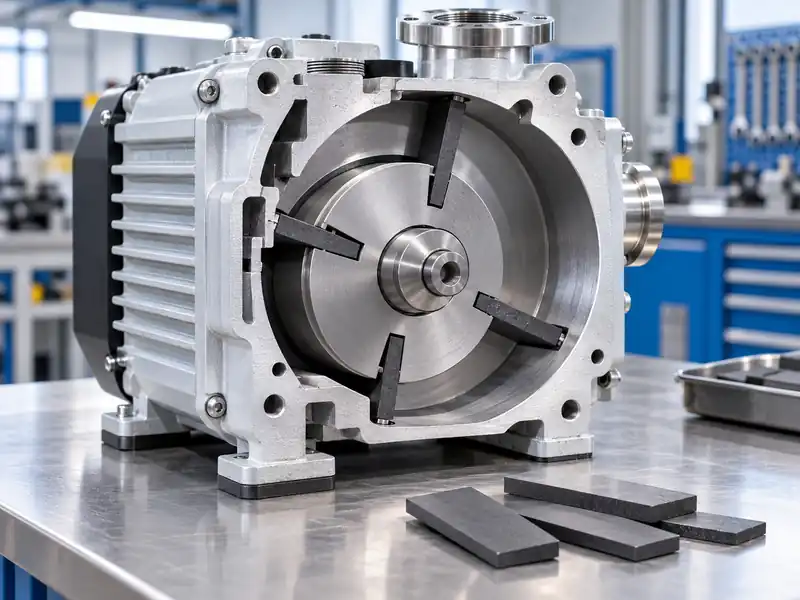
Dry-Running Carbon Graphite Vanes
Carbon graphite vanes for selected rotary vane pumps designed to operate without lubricating oil in the pumping chamber. Application-matched carbon graphite provides the sliding material required by these dry-running designs.
CARBOLVE supports drawing-based length, height, thickness, chamfers and slots for replacement requirements.
- Match the complete pump model, vane geometry and quantity per set.
- Consider operating temperature, humidity and duty cycle.

Oil-Lubricated Vacuum Pump Vanes
Custom vane options for selected oil-lubricated rotary vane pumps. Carbon-fiber composite, glass-fiber and resin-impregnated carbon constructions are evaluated where the original pump specification calls for an appropriate material.
A material change requires technical review. These options are not automatic substitutes for metal vanes or other original constructions.
- Identify the original material and operating lubricant.
- Match the finished profile, thickness and pump-specific arrangement.
Representative vane configurations. Material and geometry depend on the pump specification.
A Nominal Length Is Not a Complete Vane Specification
Catalogue descriptions often highlight one dimension. A replacement also needs the correct thickness, radial height, edge shape and material. A vane that looks similar may not move correctly in the rotor slot.

- L Length
- H Radial height
- T Thickness
- E Edge profile
- S Slot, where specified
Identification diagram only. Production dimensions follow the agreed drawing.
| Identification detail | What it establishes |
|---|---|
| Pump manufacturer, full model and version | The actual vacuum pump fitted to the machine—not just the milking equipment brand |
| Original part reference | A starting point for identifying the required component and revision |
| Length, radial height and thickness | The complete dimensional relationship with the rotor and pumping chamber |
| Bevels, chamfers, radii and slots | Features that distinguish otherwise similar vane profiles |
| Original material and lubrication type | Whether the proposed construction belongs in that pump design |
| Pieces per pump or set | The quantity being ordered; a vane set is not necessarily a complete service kit |
Use Worn Samples with Care
Wear can reduce the original vane dimensions. A used or broken sample can help identify the shape, but its remaining height should not automatically become the new-part specification. CARBOLVE reviews drawings, samples and equipment references together before agreeing the replacement geometry.
Choose Material for the Operating Conditions
There is no universal “best” vane material for milking equipment. The choice depends on the pump’s lubrication system, sliding conditions, temperature, humidity and original construction.
| Material option | Selection direction | Boundary to retain |
|---|---|---|
| Carbon graphite | A principal option for suitable dry-running rotary vane pumps | Grade and geometry must suit the specific pumping chamber and operating conditions. |
| Carbon-fiber composite | Available for review when the specified vane construction requires it | Reinforcement and binder construction matter; appearance alone does not identify the material. |
| Glass-fiber material | Available for selected drawing-based replacement requirements | The construction must be evaluated with the original design and operating lubricant. |
| Resin-impregnated carbon | Available where a treated carbon construction is required | Treatment does not automatically establish suitability for every oil, cleaning agent or moisture condition. |
CARBOLVE Material References
CVV-CG20 and CVV-CG30 identify carbon graphite directions for preliminary dry-running selection. CVV-FG30 provides a fine-grain carbon graphite reference, while CVV-RG20 and CVV-RG30 identify resin-treated carbon graphite directions for application review.
These are preliminary material references, not approved milking-pump equivalents or guaranteed operating limits. Carbon-fiber and glass-fiber constructions require separate material identification.
Humid air and liquid entering the pump are different conditions. Material selection does not replace the system’s liquid-trap, separation or maintenance requirements.
Look Beyond the Vanes When Vacuum Performance Changes
The pump removes air from the milking system. Vacuum regulation, leakage, filtration and liquid separation also influence operation. Changing vanes alone will not correct every vacuum problem.
Simplified air path. Actual components and arrangement follow the equipment design.
| Situation | Why it matters | Appropriate response |
|---|---|---|
| Vacuum fluctuates or recovers slowly | Air leakage, regulation or restrictions may be involved as well as pump wear | Have the system and pump checked before selecting replacement parts. If vane wear is confirmed, identify the original geometry and material. |
| Milk, wash liquid or condensate reaches the pump | Deposits, corrosion or other damage may extend beyond the vanes | Stop and follow the equipment service procedure. Correct the source of liquid ingress before returning the pump to use. |
| Replacement vanes bind or wear unevenly | Material mismatch, dimensional differences or existing pump damage may be responsible | CARBOLVE can manufacture to agreed material and geometry requirements; rotor and chamber condition need separate assessment. |
Note: These products are intended for the vacuum-generation side of the equipment. No direct milk-contact approval is claimed.
Manufacturing Around the Replacement Requirement
1 Material and Geometry Reviewed Together
CARBOLVE’s scope includes carbon graphite, carbon-fiber composite, glass-fiber and resin-impregnated carbon vanes. The material discussion is linked to the required component geometry and operating conditions.
2 Custom Features, Not Just Cut-to-Length Blanks
Drawing-based manufacturing can include thickness, radial height, chamfers and slots as well as length. This supports replacements that cannot be identified by a simple rectangular size description.
3 A Clear Specification for Repeat Orders
Agreed dimensions, material references, inspection requirements and packing quantities give maintenance companies and distributors a defined basis for subsequent orders.

From Drawing Review to Final Checks
CARBOLVE manufactures carbon and graphite components in Nantong, China. Replacement projects are reviewed using drawings, physical samples, equipment references and operating requirements.
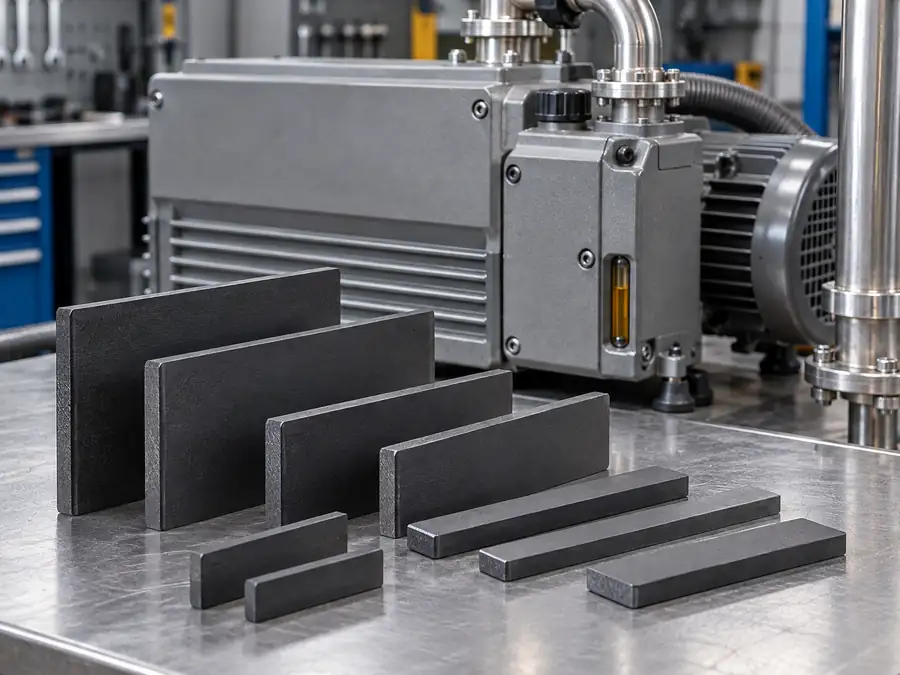
Carbon component machining
Machining and Finishing
Manufacturing capabilities include grinding, drilling, slotting and surface finishing for agreed component geometries.
Inspection Through Production
Incoming material review, in-process checks, surface inspection and final verification form part of the production workflow. Inspection requirements are established for the component being supplied.
Identification and Protective Packing
Final checks cover the agreed appearance, quantity, identification and packing requirements. Protective packing and export coordination support shipment of the finished components.

Packed cartons secured for shipment
Milking Vacuum Pump Vane Buying and Maintenance Guide
Guide Contents
Which replacement vanes are right for my milking machine?
Start with the vacuum pump, not whether the machine milks cows, goats or sheep. Identify the full pump model, lubrication system, original material and complete vane dimensions.
CARBOLVE offers dry-running carbon graphite vanes and drawing-based options for selected oil-lubricated pumps. Compatibility is reviewed for the actual pump configuration.
Some milking systems use piston, lobe or other pump technologies instead of sliding vanes. “Oil-free” alone does not identify a carbon-vane pump.
What causes premature vane failure?
Excessive heat, contamination, unsuitable lubrication, incorrect material or geometry, and operation beyond wear limits can contribute.
In dairy systems, suspected liquid ingress also needs investigation. Replacing damaged vanes without addressing the underlying condition can leave the same problem unresolved.
How often should vanes be inspected or replaced?
Follow the pump manufacturer’s inspection schedule and wear limits. There is no single interval suitable for every portable milker or fixed installation.
Record operating hours and inspection findings. Changes in noise, temperature or vacuum performance warrant investigation rather than waiting for the next planned replacement.
How should replacement vanes be installed?
Use a trained technician and the procedure for the exact pump model. Before work, isolate power, prevent automatic restart, release stored pressure or vacuum, and allow hot parts to cool.
Orientation, cleaning methods, clearances, lubricant and fastener torque are model-specific. Do not oil a chamber designed for dry-running operation.
After service, have the pump and milking vacuum system checked according to the equipment requirements before use.
Where can I source replacement vane sets?
CARBOLVE supplies from China for replacement and custom-manufacturing projects. Requests can be reviewed from a drawing, sample, pump reference and known material information.
Compare quotations on the same basis:
- Material and finished geometry
- Pieces per set and number of sets
- Included components
- Inspection requirements
- Delivery destination and shipping arrangements
A vane set does not automatically include filters, seals, bearings or lubricant. Confirm the quoted scope. Local stock, delivery timing and original-brand status should be verified separately rather than inferred from a product name.
Related Vane Products and Manufacturing Options
Request Vanes for Your Milking Vacuum Pump
Include the pump’s full model, original part reference or drawing, and the quantity required. If you are working from a sample, let us know whether it is new, worn or broken.
Drawings and sample photographs can also be emailed to sales@carbolve.com.