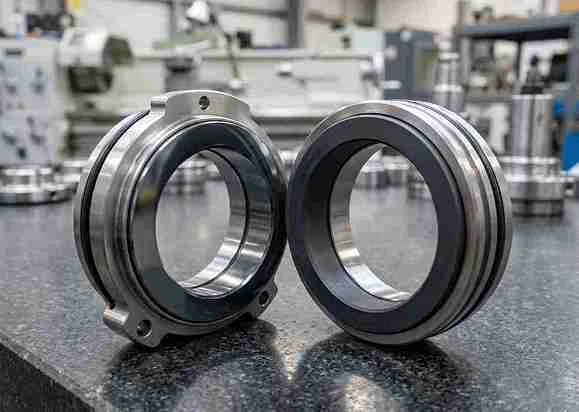
Segmented Carbon Seal Rings Manufacturer
CARBOLVE manufactures precision segmented carbon seal rings and carbon-graphite segment sets according to drawings, physical samples, and operating conditions. Designed for applicable steam turbines, compressors, blowers, and rotating shaft equipment requiring circumferential sealing. Ring clearance, segment geometry, and material must be confirmed for the actual shaft diameter, temperature, pressure, speed, and complete sealing-system design.
- Custom Segmented Ring Machining
- Drawing & Sample-Based Production
- Matched Segment Geometry
- OEM & Replacement Support
Send the shaft diameter, assembled ring dimensions, number of segments, joint style, carbon grade if known, operating temperature, pressure, speed, equipment model, and quantity.

What Does CARBOLVE Supply?
CARBOLVE Core Product Scope
- Carbon ring segments
- Carbon graphite segmented ring sets
- Split carbon seal rings & Carbon packing rings
- Custom ring geometry (Butt / overlap joints)
- Spring grooves & Anti-rotation features
- Replacement and obsolete carbon rings
Complete Seal-System Components (Require Verification)
Unless specifically verified, CARBOLVE should be described as the manufacturer of the carbon/graphite sealing components rather than the complete circumferential seal system. The following may not be supplied unless confirmed:
- • Housing / Glands / Backplates
- • Garter springs / Axial compression springs
- • Retainers / Metal carriers / Pins / Keys
- • Buffer gas connections / Extraction systems
- • Complete turbine gland assemblies
Segmented Carbon Seal Rings by Requirement
Steam Turbine Carbon Packing Rings
For applicable turbine shaft/gland systems. Requires shaft diameter, steam conditions, temperature, speed, and existing ring geometry.
Compressor Carbon Seal Rings
For verified compressor circumferential shaft-seal applications requiring segmented construction.
Blower Carbon Seal Rings
For applicable gas/air sealing systems requiring precision-machined carbon segments.
Split Carbon Seal Rings
For installation or maintenance designs requiring segmented construction around existing shafts.
Overlap-Joint Carbon Rings
Manufactured only according to approved matched geometry and dimensional tolerances.
Butt-Joint Carbon Rings
Precision-machined segment ends meeting according to approved seal-system geometry.
Hydro / Gas Turbine Rings
Supported only where CARBOLVE capability and material suitability are verified for the specific equipment.
Replacement / Obsolete Rings
Manufactured from OEM numbers, machine models, drawings, physical samples, or broken segments.

What Are Segmented Carbon Seal Rings?
Segmented carbon seal rings are circumferential sealing components formed from multiple precision-machined carbon or carbon-graphite segments assembled around a shaft or rotor.
Their segmented construction allows installation around shafts and enables the seal system to accommodate application-specific movement, wear, thermal expansion, or assembly requirements. Important components and features may include the carbon segments, segment joints, ring ID/OD, side faces, spring grooves, anti-rotation features, garter springs (where applicable), and the surrounding housing or chamber.
How Do Segmented Carbon Seal Rings Work?
- Multiple matched carbon segments form a ring around the rotating shaft.
- The segments are positioned by the surrounding seal system.
- A spring, pressure differential, housing geometry, or combination may influence ring position.
- The ring controls leakage circumferentially around the shaft.
- Depending on design, the ring may operate in contact, intermittent contact, or with a controlled clearance.
- Additional rings may be installed in series to create a multi-stage leakage path.

Segmented Carbon Ring vs. Mechanical Seal Face
Segmented carbon seal rings and mechanical seal faces are different sealing technologies and should not be treated as interchangeable carbon rings.
Segmented Carbon Seal Ring
- Primary Sealing Direction: Circumferential / radial around the shaft.
- Typical Form: Multiple carbon segments forming a ring around the shaft, spring or housing-supported depending on design.
- Common Applications: Turbines, compressors, blowers, pumps, rotating equipment.
Mechanical Seal Face
- Primary Sealing Direction: Axial / end-face.
- Typical Form: Precision-lapped face pair (rotary face + stationary face).
- Common Applications: Pumps, mixers, agitators.
Why Use a Segmented Ring Instead of a Solid Carbon Ring?
Possible engineering reasons to choose a segmented construction include:
- Installation around an existing shaft without complete disassembly
- Easier maintenance in specific machine designs
- Accommodation of radial shaft movement
- Ability to use external spring loading for positioning
- Thermal expansion management
- Feasibility for very large shaft diameters
- Matched multi-piece geometry for specific leakage control
Benefits depend strictly on the complete seal-system design. Do not assume segmented rings are universally easier to install or provide longer life without evaluating the application.

Ring Construction & Joint Geometry

Segment Quantity
There is no universal number of segments (e.g., 2, 3, 4, or 6). The required number depends on ring diameter, seal design, joint design, installation requirements, and radial movement. The segment count should follow the approved seal design or verified original ring.

Segment Joints
Butt Joint: Segment ends meet at a controlled joint.
Overlap / Lap Joint: Segment ends overlap to modify the leakage path. Joint geometry should not be redesigned from appearance alone; it requires approved drawings.

Garter Springs & Retaining
Many designs use an external garter/extension spring for radial positioning. However, spring force, material, and design are highly application-specific. Not every ring uses the same spring design. CARBOLVE supplies springs only where capability is verified.
Contact vs. Controlled-Clearance Designs
Do not assume a segmented carbon ring is either a permanent contact seal or a permanent non-contact seal without confirming the original design.
Contact / Rubbing Design
The ring operates against the shaft. Main considerations include friction, wear, shaft surface finish, material pairing, and heat generation.
Controlled-Clearance / Floating Design
A designed radial gap is maintained. Main considerations include operating clearance, leakage targets, thermal expansion, shaft movement, and pressure.
Single-Ring vs. Multi-Stage Seals

Single Ring
One ring controls the primary circumferential leakage path.
Multi-Stage
Several rings arranged in series. Spaces between stages may be used for pressure reduction, leakage collection, venting, buffer gas, or extraction, depending on the complete seal system.
Carbon Materials for Segmented Seal Rings
"Segmented Carbon Seal Rings" describes a product structure, not a single carbon grade. The correct grade depends on the seal design, media, temperature, pressure, speed, shaft material, and operating environment.
Carbon Graphite & Graphite
Common mechanical carbon material families. Selection depends on required mechanical strength, friction, and thermal properties.
Electrographite
Used in specific segmented seal-ring designs requiring different thermal and friction behavior compared to standard carbon graphite.
Impregnated Carbon Graphite
Resin, metal, or antimony impregnation may alter permeability, strength, chemical compatibility, and temperature limits. (Subject to CARBOLVE verified supply).
| Property | Unit / Format | Why It Matters | CARBOLVE Data |
|---|---|---|---|
| Material Grade | — | Material identification | [Insert verified CARBOLVE material grade] |
| Density | g/cm³ | Material consistency | [Verified] |
| Hardness | Verified scale | Wear / machining | [Verified] |
| Flexural Strength | Verified unit | Segment fracture resistance | [Verified] |
| Thermal Expansion | Verified unit | Operating clearance calculation | [Verified] |
| Maximum Temperature | Application dependent | Material suitability | [Verified operating limit] |
Engineering Considerations
Why Shaft Clearance Matters

The correct radial relationship between the carbon ring and shaft affects leakage, contact, heat generation, wear, and segment stability.
Never assume a universal segmented carbon ring clearance. Clearance should follow the approved seal design and operating condition, influenced by shaft diameter, carbon grade, temperature, pressure, and shaft motion.
Operating Temperature & Clearance

Segmented carbon ring clearance should be evaluated at operating conditions, not from shaft diameter alone. Both the shaft material and the carbon material change dimensions with temperature.
Shaft Surface Requirements

Ring performance depends heavily on the mating shaft or sleeve. A new carbon ring cannot compensate for a severely damaged shaft.
- Check shaft/sleeve material & coating
- Check surface finish & hardness
- Inspect for scoring, grooves, corrosion
- Evaluate runout and eccentricity
How to Identify Replacement Segmented Carbon Seal Rings
The strongest replacement evaluation combines ring geometry, shaft information, and operating conditions. CARBOLVE manufactures from several starting points.
1. From Your Drawing
We review revision, material, segment count, ID/OD/width, joint geometry, spring grooves, and tolerances before manufacturing to approved specifications.
2. From a Physical Sample
Send a complete ring set if possible. We measure segments, assemble geometry, inspect wear, and propose specifications based on operating data.
3. Worn or Broken Rings
A worn ring helps identify segment count and basic geometry, but may not reveal original unworn ID, exact carbon grade, or OEM design limits.
4. OEM Part Number
OEM numbers are used as identification references. Final specification should be confirmed against available drawings, equipment info, and operating data.
Common Segmented Carbon Seal Ring Problems
Excessive Steam/Gas Leakage
Possible contributors: Excessive clearance, worn ID, worn joints, damaged shaft, incorrect segment geometry, or system condition.
Rapid Carbon Wear
Possible contributors: Shaft surface condition, incorrect material, high contact pressure, excessive heat, or contamination.
Broken Segments
Possible contributors: Mechanical shock, sudden shaft excursion, incorrect clearance, binding, assembly error, or foreign material.
Shaft Scoring
Possible contributors: Carbon debris, contamination, incorrect material pair, damaged ring, or excessive loading.
Segments Do Not Move Freely
Possible contributors: Deposits, carbon dust build-up, damaged housing, incorrect geometry, or spring problems.
Uneven Ring Wear
Possible contributors: Shaft runout, eccentricity, housing misalignment, uneven loading, or a damaged shaft.

How CARBOLVE Manufactures Finished Segmented Rings
We focus on precision finished-ring machining from verified carbon and graphite materials.
-
1
Material & Blank Preparation Confirm approved carbon/graphite grade and prepare suitable material blank.
-
2
Precision Machining & Segment Cutting Machine initial ID/OD/width, cut required number of segments, and machine butt or overlap joints.
-
3
Features & Segment Matching Machine spring grooves, stops, or keys where required. Match mating segment joints.
-
4
Quality Control & Packaging Inspect assembled ring dimensions, joint matching, and surface condition. Package to protect brittle carbon edges.
Frequently Asked Questions
Are segmented carbon rings the same as mechanical seal faces?
How many segments are used in a carbon seal ring?
Do segmented carbon rings contact the shaft?
What is carbon ring running clearance?
Which is better: butt joint or overlap joint?
Can CARBOLVE reproduce a worn carbon ring?
Does replacing carbon rings always solve leakage?
Does CARBOLVE supply springs with carbon rings?
Need Segmented Carbon Seal Rings for a Turbine or Rotating Shaft?
Complete shaft, material, segment, joint and operating information helps CARBOLVE evaluate ring geometry, material requirements, manufacturing feasibility and inspection requirements.
Quotation Checklist
Not every field is required immediately. Send what you have.
- • Equipment Manufacturer/Model
- • OEM Part Number
- • Shaft Diameter & Material
- • Assembled Ring ID/OD/Width
- • Segment Count & Joint Type
- • Existing Carbon Grade
- • Operating Media
- • Temperature & Pressure
- • Shaft RPM & Movement
- • Existing Leakage/Wear Problem
Email: sales@carbolve.com | Phone: +86(513)-81100106