Generator Brushes Manufacturer
CARBOLVE manufactures generator brushes for applicable portable brush-type generators, engine-driven generator sets, industrial synchronous generators, DC generators, wind generators, hydro generators, turbogenerators, and welding generators. We support OEM projects and replacement requirements with custom brush dimensions, brush sets, assemblies, and custom shunts. Brushless generators do not use conventional excitation brushes.
- Custom Generator Brush Manufacturing
- Portable and Industrial Generator Applications
- Slip-Ring and Commutator Brush Support
- Drawing and Sample-Based Production
- OEM and Replacement Support
Send the generator manufacturer, model, part number, brush dimensions, contact-surface information, electrical data, existing problem, and required quantity for evaluation.
Carbon Brushes for Different Generator Systems
The correct generator brush depends on the generator type, electrical function, slip ring or commutator, current, speed, brush holder, duty cycle, environment, material, and construction. CARBOLVE manufactures brushes for the following verified systems.

Portable-Generator Brush Assemblies
For gasoline and diesel portable generators using brush-type rotor excitation. Compact holder assemblies with model-specific dimensions, springs, and connector terminals for OEM and replacement projects.
Ask About Portable-Generator Brushes →
Industrial Synchronous-Generator Brushes
Field-excitation applications operating on collector rings in medium- and large-generator systems. Available in multiple-brush arrangements with industrial shunts and terminals.
Discuss an Industrial Generator →
DC-Generator and Dynamo Brushes
Designed for segmented commutators to collect generated current. Used in legacy equipment, tractor generators, welding generators, and motor-generator sets.
Ask About DC-Generator Brushes →
Wind-Generator Brushes
Rotor current transfer for doubly fed induction generators. Power slip ring brushes manufactured from application-specific materials for wind-turbine generator maintenance.
Discuss a Wind-Generator Application →
Hydro-Generator Brushes
Excitation collector ring brushes for large brush holders. Selected for low- or variable-load conditions, humidity resistance, and reliable generator maintenance.
Ask About Hydro-Generator Brushes →
Turbogenerator and Exciter Brushes
Static excitation for high-speed generator systems. Collector-ring applications and exciter-generator brushes utilizing application-specific graphite materials (where verified).
Discuss a Turbogenerator Requirement →
Replacement Generator Brushes
Identified by generator model, OEM part number, brush marking, existing assembly, physical sample, worn dimensions, or existing failure pattern.
Identify a Replacement Generator Brush →
Custom Generator Brushes
Drawing-based production for non-standard dimensions, custom contact faces, multiple shunts, custom terminals, top pads, and multi-section constructions.
Request a Custom Generator Brush →Not Sure Which Generator Brush You Need?
What Is a Generator Brush?
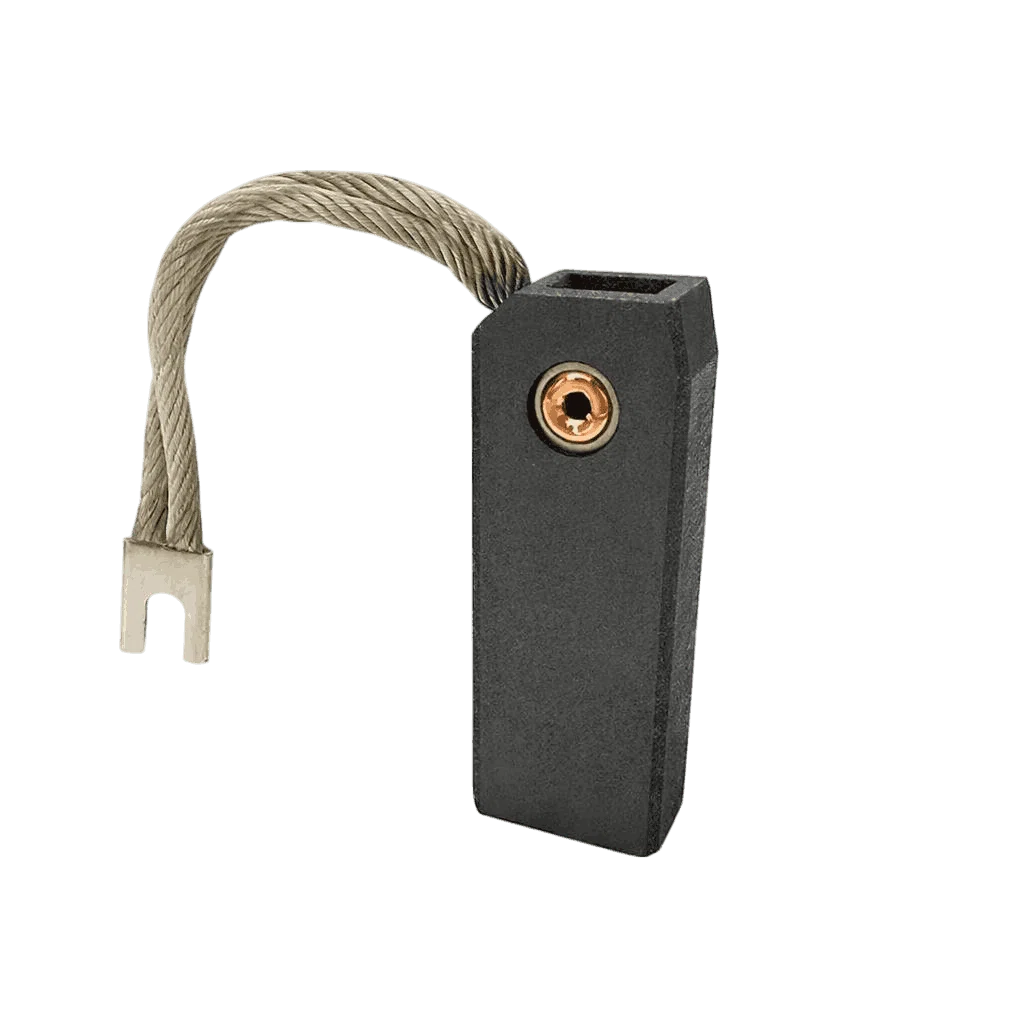
A generator brush is a sliding electrical contact that transfers current between stationary and rotating components in a brush-based generator. Depending on the generator design, it may supply rotor excitation current through slip rings, transfer rotor current through collector rings, or collect generated current through a commutator.
A complete generator-brush product may include:
- Carbon or graphite brush body
- Contact face
- Flexible shunt or lead
- Terminal
- Top pad
- Spring
- Holder or mounting block
- Part or grade marking
Note: Not every generator brush includes every component.

How Do Generator Brushes Transfer Current?
Brush-Type Synchronous Generator
- The excitation or regulator system supplies controlled field current.
- The brush holder and spring maintain brush contact with the rotor slip rings.
- Current passes through the shunt and carbon brush.
- The slip rings transfer current into the rotating field winding.
- The rotating magnetic field induces electrical output in the stator.
DC Generator
- Mechanical energy rotates the armature.
- Voltage is generated in the armature winding.
- The segmented commutator mechanically rectifies the armature output.
- Carbon brushes collect current from the commutator.
- Current passes into the external circuit.
Doubly Fed / Wound-Rotor Generator
- Rotor windings connect to continuous slip rings.
- Brushes maintain electrical contact with the rings.
- Rotor current passes between the generator and external converter or control system.
- Brush, ring, holder, and converter conditions affect performance.
Performance Factors
Performance is affected by: Generator design, electrical function, brush material, dimensions, contact area, brush pressure, holder alignment, slip-ring or commutator material, surface finish, current, speed, duty cycle, temperature, humidity, dust, oil, chemicals, vibration, and altitude.

Which Generators Use Carbon Brushes?
The word "generator" alone is not sufficient for brush selection. Confirm the generator design, rotating contact surface, electrical function, manufacturer, model, and existing brush.
| Generator Type | Conventional Carbon Brushes? | Contact Surface | Brush Function |
|---|---|---|---|
| Brush-type synchronous generator | Yes | Slip rings or collector rings | Supplies rotor excitation current |
| Brushless synchronous generator | No conventional excitation brushes | Brushless exciter | Generator brushes normally do not apply |
| Portable brush-type generator | Design dependent | Slip rings | Supplies rotor excitation current |
| Permanent-magnet generator | Normally no excitation brushes | Permanent magnets | Confirm the complete design |
| DC generator or dynamo | Yes | Segmented commutator | Collects generated current |
| Doubly fed induction generator | Yes | Slip rings | Transfers rotor current |
| Wind direct-drive PM generator | Normally no excitation brushes | Permanent magnets | Grounding contacts may be separate |
| Hydro generator | Design dependent | Collector rings or brushless exciter | Confirm excitation system |
| Turbogenerator | Design dependent | Collector rings or brushless exciter | Confirm excitation design |
| Welding generator | Design dependent | Slip rings or commutator | Confirm machine type |
| Automotive alternator | Often uses brushes | Slip rings | Use the dedicated Alternator Brushes page |
| Inverter generator | Design dependent | Varies by design | Do not assume brushes are present |
Generator Brush Supply & Construction Options

Loose Generator Brush
A carbon or graphite brush body supplied with only the specified attached components (shunt, terminal, top pad, spring).

Generator Brush Set
A specified quantity supplied for one generator, ring, commutator, brush arm, or maintenance replacement.

Portable Brush Assembly
A compact brush-and-holder unit for a verified generator design, including holder block, springs, and terminals.

Multiple-Shunt Brush
A brush with two or more shunts where current distribution, flexibility, or construction requires them.

Multi-Section Brush
Two or more brush wafers operating together according to the approved holder and generator design.

Custom Contact Face
Flat, radiused, beveled, grooved, angled, split, or application-specific geometry.
Materials for Generator Brushes
There is no single carbon-brush material suitable for every generator. Selection depends on generator type, electrical function, contact surface, voltage, current, speed, pressure, duty cycle, and environment.
| Material Family | General Direction | Possible Generator Application | Required Information |
|---|---|---|---|
| Graphite | Application-specific lower-friction direction | Selected medium- or high-speed slip rings | Speed, current, ring and environment |
| Electrographite | Balanced industrial electrical and mechanical direction | Industrial generators, exciters and selected commutators | Generator and operating data |
| Carbon graphite | Grade-dependent resistance and cleaning direction | Selected legacy or lower-speed equipment | Existing brush and contact surface |
| Copper graphite | Higher-conductivity direction | Selected low-voltage or high-current systems | Current, voltage, contact surface and speed |
| Silver graphite | Specialized low-resistance direction | Selected grounding, signal or precision contacts | Electrical function and ring data |
This table provides general material directions only. Final material selection requires complete generator and operating information.
Information Required for Brush Selection
Generator & Electrical Parameters
- Generator Type: Portable, synchronous, DC, wind, hydro, etc.
- Identification: Manufacturer, Model, Serial, Genset info
- Excitation System: Brush type, brushless, static, AVR, converter
- Electrical Function: Excitation, rotor current, output, grounding
- Ratings: Voltage, Frequency, Rated output
- Current: Rotor/field current, Current per brush
- Operation: Rotational speed, Duty cycle, Load profile
Contact Surface & Holder
Slip-Ring / Collector-Ring Information
Commutator Information
Brush-Holder Information
The same brush material should not be transferred between a slip-ring and commutator application without technical review.
Common Generator Brush Problems
Generator Produces No Voltage
Factors: Worn/sticking brushes, broken shunt, dirty slip rings, faulty AVR, open rotor, loss of residual magnetism.
CARBOLVE Response: Review the brush system together with the excitation circuit, rotor, AVR, and slip rings. Replacing brushes alone may not restore output.
Rapid Brush Wear
Factors: Incorrect material, excessive pressure, rough surface, high speed, vibration, low humidity, abrasive contamination.
CARBOLVE Response: Evaluate operating conditions, contact surface, and environment to select a suitable material grade.
Excessive Sparking or Arcing
Factors: Poor contact, incorrect material, ring/commutator damage, current overload, brush bounce, incorrect neutral position.
CARBOLVE Response: Review electrical load, contact stability, and surface condition.
Slip-Ring Scoring or Grooving
Factors: Hard contamination, damaged brush edges, excessive pressure, incorrect material, misalignment, ring runout.
CARBOLVE Response: Inspect ring finish and ensure brush material matches the operating requirements.
Brush Sticking
Factors: Incorrect dimensions, rough brush sides, carbon dust, oil, corrosion, holder deformation, heat.
CARBOLVE Response: Verify precise dimensional tolerances and holder clearances.
Difficult-to-Identify Replacement
Factors: Missing drawings, obsolete parts, unreadable markings, unknown generator models.
CARBOLVE Response: We evaluate generator labels, part numbers, dimensions, assembly photos, and physical samples to identify a solution.
Custom Generator Brushes for OEM and Power-Generation Projects
CARBOLVE can evaluate portable-generator brush assemblies, industrial synchronous-generator brushes, DC-generator brushes, wind-generator brushes, hydro-generator brushes, turbogenerator brushes, and welding-generator brushes. We support existing OEM specifications, replacement products, obsolete brushes, drawing-based production, and sample-based reproduction.
Final material, dimensions, construction, compatibility, inspection, feasibility, and pricing must be confirmed after technical review. We support trial quantities, maintenance quantities, batch production, and repeat orders.

How CARBOLVE Handles a Generator Brush Inquiry
Submit Info
Send drawing, sample, photos, model, part number, dimensions, and quantity.
Identify Gen
Confirm portable, sync, DC, wind, hydro, turbo, or welding generator.
Electrical Function
Confirm rotor excitation, rotor current, output collection, or grounding.
Contact Surface
Confirm slip ring, collector ring, or segmented commutator.
Review Conditions
Review voltage, current, speed, environment, and existing problem.
Confirm Geometry
Confirm thickness, width, length, contact face, and bevel.
Confirm Construction
Confirm shunts, terminal, top pad, spring, holder, and marking.
Quotation
Confirm material, dimensions, quantity, inspection, and terms.
Sample Validation
Validate prototype or initial sample where required.
Batch Production
Proceed after drawing, specification, or sample is approved.

How to Measure a Generator Brush for Replacement
- Thickness (T): Measure the dimension fitting between the sides of the brush-holder pocket.
- Width (W): Measure the other cross-sectional dimension.
- Length (L): Measure the total brush-body length. (A worn brush may not show the original length).
- Contact Face: Record whether the face is flat, radiused, beveled, grooved, angled, or split.
- Shunts & Terminals: Record number, position, exposed length, terminal shape, hole size, and orientation.
- Tools: Use a vernier caliper, micrometer, radius gauge, and take clear camera photographs.
Dimensions alone may not identify the correct brush material or generator application.
Frequently Asked Questions
Do all generators use carbon brushes?
Do generator brushes carry the full generator output current?
Does replacing the brushes always solve a generator-output problem?
How long do generator brushes last?
Request a Custom Generator Brush Quote
Complete generator, electrical, dimensional, contact-surface, and operating information helps CARBOLVE evaluate material direction, brush construction, and manufacturing feasibility.