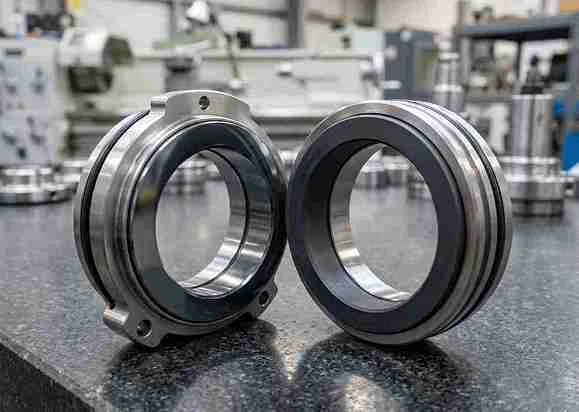
Slip Ring Carbon Brushes Manufacturer
CARBOLVE manufactures custom, OEM, and replacement slip ring carbon brushes for applicable wound-rotor motors, slip-ring induction motors, generators, excitation systems, wind-energy generators, hydro generators, and rotary current-transfer systems. We support custom materials, dimensions, shunts, terminals, and multi-section designs based on drawings or physical samples.
CARBOLVE’s core product on this page is the carbon brush used on continuous slip rings or collector rings. Complete slip-ring assemblies are subject to separate capability confirmation.
Send the machine type, ring diameter, current per brush, speed, brush dimensions, and operating environment for technical evaluation.

Product Scope: Slip Ring Carbon Brush vs Complete Assembly
CARBOLVE supplies carbon brush components for slip-ring systems. Complete slip-ring assembly supply is subject to separate capability confirmation.
Slip Ring Carbon Brush
→ CARBOLVE Core Product
A replaceable carbon or graphite sliding-contact component that runs against an existing slip ring or collector ring.
- Replacement carbon brush
- Custom carbon brush
- Brush with shunt & terminal
- OEM carbon brush
Carbon Brush Slip Ring
→ Complete Assembly (Not automatically included)
A complete electromechanical rotary-current-transfer assembly.
- Conductive rings & brushes
- Brush holders & housing
- Rotor, stator & bearings
- Wiring & insulation
What Are Slip Ring Carbon Brushes?
A slip ring carbon brush is a replaceable sliding electrical contact used to transfer current between stationary and rotating components through a continuous conductive ring. The brush is held against the slip ring by a brush holder and spring, while a flexible shunt or terminal connects it to the stationary electrical circuit.
Possible components include the carbon or graphite brush body, contact face, flexible shunt, terminal, top pad, spring, wear mark, or multiple sections. Not every brush includes every component.

Slip Ring Carbon Brushes for Different Electrical Systems
The correct brush depends on machine type, electrical function, current, speed, ring dimensions, and operating environment.

Wound-Rotor Motor Brushes
For wound-rotor induction motors and slip-ring asynchronous motors. Main function: Rotor-current transfer through continuous slip rings.
Ask About Wound-Rotor Motor Brushes →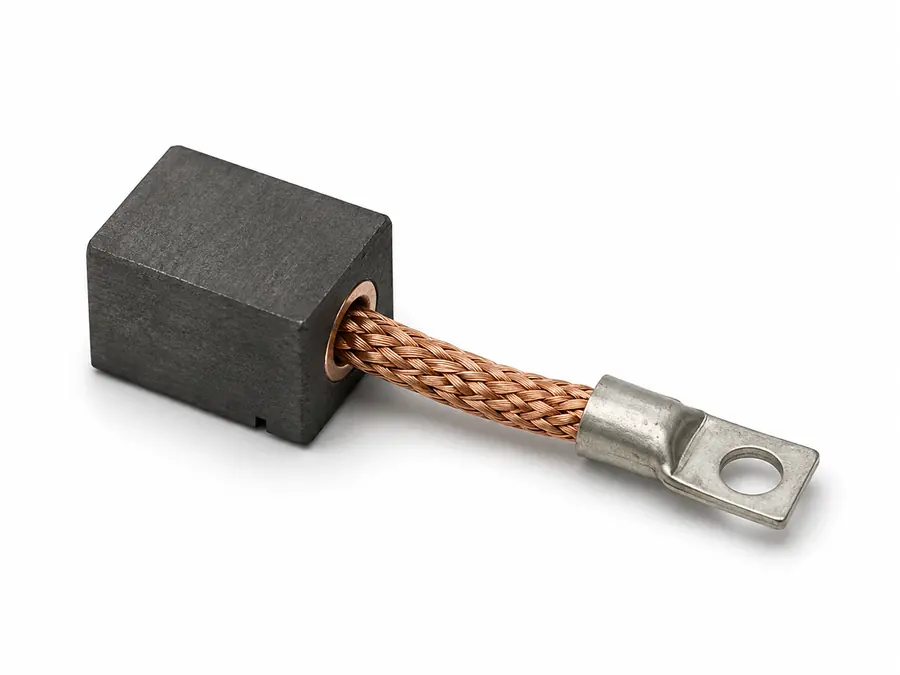
Generator Excitation Brushes
For applicable generators using collector rings or slip rings to supply rotor field current.
Discuss Generator Excitation Brushes →
Wind Generator Brushes
For applicable wound-rotor or doubly fed induction generator systems.
Discuss a Wind Generator Application →
Hydro Generator Brushes
For applicable excitation collector-ring systems in hydropower facilities.
Ask About Hydro Generator Brushes →
Turbogenerator Brushes
For verified high-speed collector-ring excitation systems.
Discuss Turbine Generator Brushes →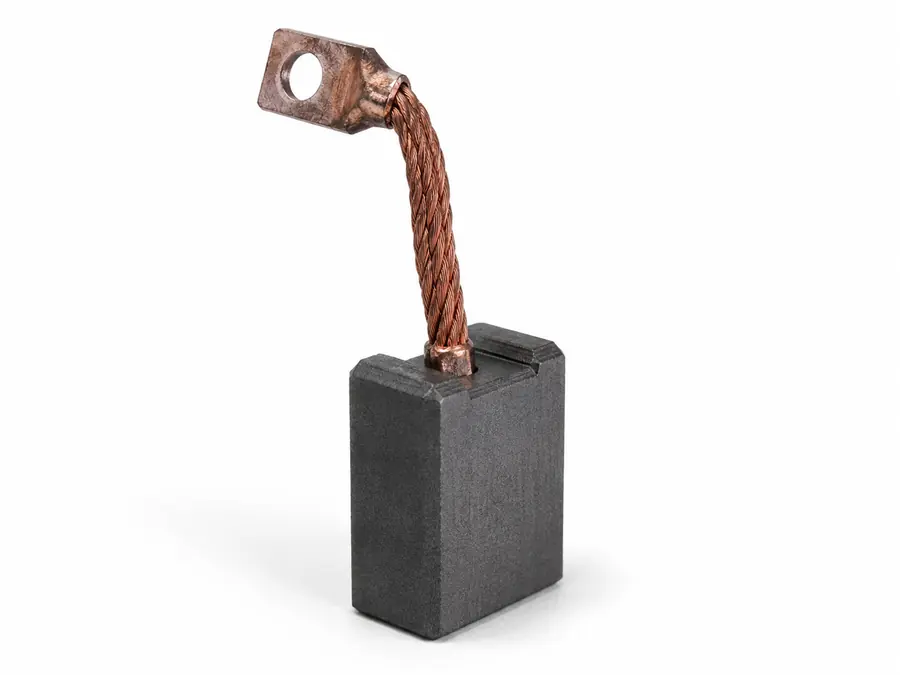
Rotary Power-Transfer
For cable reels, cranes, rotating tables, industrial machinery, and current-transfer assemblies.
Discuss Rotary Power Transfer →
Signal-Transfer Brushes
For selected low-level measurement, control systems, and automation (subject to verified capability).
Ask About Signal-Transfer Brushes →
Custom & Replacement
For obsolete products, existing samples, custom dimensions, special terminals, and multi-section constructions.
Identify a Replacement Slip-Ring Brush →How Do Slip Ring Carbon Brushes Work?
-
1
A stationary electrical circuit connects to the carbon brush through its terminal and flexible shunt.
-
2
The brush holder and spring maintain controlled mechanical contact between the carbon brush and rotating slip ring.
-
3
Electrical current passes through the brush-to-ring contact interface.
-
4
The continuous slip ring carries the electrical connection into or out of the rotating circuit.
-
5
As the ring rotates, continuous sliding contact allows electrical transfer without twisting a fixed electrical conductor.
Electrical function depends on the machine (e.g., rotor current for wound-rotor motors, excitation current for synchronous generators). Performance depends on material, contact area, current, speed, pressure, ring surface, temperature, and ventilation.

Slip Ring vs Commutator
A carbon brush designed for a slip ring should not automatically be used on a commutator simply because its dimensions are similar.
| Factor | Slip Ring | Commutator |
|---|---|---|
| Surface | Continuous conductive ring | Segmented conductive surface |
| Main purpose | Continuous electrical transfer | Electrical transfer plus mechanical switching |
| Common machines | Wound-rotor motors, generators, rotary systems | DC motors, universal motors, DC generators |
| Brush interaction | Continuous running track | Brush passes across individual segments |
| Typical brush selection | Current, speed, ring material, heat, environment | Current, commutation, neutral position, segment condition |
| Typical problems | Ring heating, scoring, oxidation, dust, uneven sharing | Sparking, threading, copper drag, grooving, poor commutation |

Which Systems Use Slip Ring Carbon Brushes?
| Machine / System | Slip Ring Brushes? | Typical Electrical Function | Verification Required |
|---|---|---|---|
| Wound-rotor induction motor | Yes | Rotor current transfer | Motor and ring data |
| Slip-ring asynchronous motor | Yes | Rotor current transfer | Current, speed and ring system |
| Synchronous generator (static excitation) | Design dependent | Rotor excitation | Generator excitation design |
| Hydro generator | Design dependent | Field excitation | Excitation-system confirmation |
| Turbogenerator | Design dependent | Rotor field current | Speed and collector-ring design |
| DFIG wind generator | Often in applicable designs | Rotor current to/from converter | Generator type and slip-ring unit |
| Automotive alternator | Often | Rotor excitation | Use dedicated Alternator Brushes page |
| Motor-driven cable reel | Often in applicable systems | Power or control transfer | Current and ring configuration |
| Crane rotating system | Design dependent | Power/current transfer | Equipment architecture |
| Brushless motor | No | N/A | Confirm machine design |
| Squirrel-cage induction motor | Normally no | N/A | Confirm motor type |
| DC motor | Commutator brushes | Motor current | Use dedicated DC Motor Brushes page |
Slip Ring Carbon Brush Supply Options
Loose Carbon Brush
Carbon body supplied with only specified attached features.
Brush With Single Shunt
One flexible lead and specified terminal.
Brush With Multiple Shunts
Two or more shunts according to current requirements.
Multi-Section Brush
Two or more carbon brush sections operating together.
Brush Pair / Matched Set
Multiple brushes supplied according to ring requirements.
Brush, brush set, holder assembly, and complete slip-ring assembly are different scopes. Quotation must state exactly what is included.
Construction Options
- Single, dual, or multiple shunts
- Multi-section or split brush
- Custom terminal lugs (eyelet, fork, flag)
- Brush with top pad or spring (where verified)
- Custom contact-face geometry
- Tamped or riveted connections (where verified)
Materials for Slip Ring Carbon Brushes
There is no single carbon-brush material suitable for every slip-ring system. Selection depends on current, speed, ring material, and environment.
Electrographite
Provides an application-dependent balance of conductivity, resistance, mechanical stability, and wear. Suitable direction for motors, generators, and industrial rings.
Graphite
Graphite-rich materials suitable for certain continuous-ring applications requiring application-specific friction and electrical characteristics.
Copper / Metal Graphite
Considered for lower contact resistance and higher current transfer. Higher metal content affects speed suitability, conductive dust, and ring wear. Selection must be specific.
Silver Graphite
Considered for specialized low-resistance contact, selected signal transmission, precision current-transfer, or grounding applications.
These categories provide general material directions only and are not a substitute for grade selection.
Custom Slip Ring Carbon Brush Specifications
| Brush Body Parameters | |
|---|---|
| Thickness / Width | Drawing, sample or holder dimension |
| Length | Original or unworn length where possible |
| Contact face | Flat, radiused, curved, angled, beveled or custom |
| Multi-section | Number, size and relationship of sections |
| Product marking | Grade, part, batch, polarity or customer reference |
| Shunt and Terminal | |
|---|---|
| Shunt quantity | None, single, dual or multiple |
| Shunt length/section | Current, flexibility dependent, confirm reference points |
| Terminal type | Lug, eyelet, flag, plate, fork, ring or custom |
| Terminal dimensions | Drawing or sample |
| Attachment method | Verified manufacturing process only |
| Electrical Information Required | |
|---|---|
| Electrical function | Rotor current, excitation, power, signal or grounding |
| Current per brush | Preferred selection parameter |
| Total brushes | Per ring and total system |
| Duty cycle | Continuous, intermittent, standby, variable |
Grade-Dependent Technical Data
Specific values for density, hardness, electrical resistivity, contact voltage drop, friction behavior, current-density capability, and peripheral-speed capability are available according to the verified CARBOLVE material grade.
Multiple Brushes on One Slip Ring
Industrial slip-ring systems often use multiple brushes in parallel. Correct current sharing depends on brush material consistency, dimensions, contact-face condition, brush pressure, shunt resistance, holder alignment, and ring surface.
Possible Problems (Unequal Sharing):
- One brush carrying disproportionate current
- Local overheating & ring hot spots
- Uneven wear or unequal brush lengths
- Burned shunts or hot terminals
Do not evaluate one brush in isolation when several brushes share current on the same ring.
Demanding Environments
High Temperature
Review material, ring heating, ventilation.
Dust & Contamination
Review carbon dust, abrasives, tracking risk.
High Speed / Vibration
Review brush stability, friction, spring behavior.
Low or Variable Load
Review contact-film behavior, wear, stability.
Common Slip Ring Carbon Brush Problems
Rapid Brush Wear
Possible contributors: Incorrect material, excessive pressure, high speed, rough ring, vibration, or incorrect current loading.
Slip Ring Overheating
Possible contributors: High current, high contact resistance, insufficient brush area, poor ventilation, or unequal current distribution.
Excessive Sparking/Arcing
Possible contributors: Unstable contact, brush bounce, damaged ring, incorrect pressure, current overload, or contamination.
Slip Ring Grooving/Scoring
Possible contributors: Hard contamination, abrasive particles, incorrect material, damaged brush, or excessive pressure.
Shunt/Terminal Heating
Possible contributors: Excessive current, insufficient shunt cross section, loose terminal, corrosion, or flex damage.
Brush Sticking
Possible contributors: Incorrect dimensions, carbon dust buildup, oil, corrosion, heat, or holder deformation.
Custom Slip Ring Carbon Brushes for OEM and MRO Projects
CARBOLVE can evaluate new wound-rotor motor projects, generator excitation projects, and industrial rotary-current-transfer projects. We work from existing OEM drawings, physical samples, or existing part information to manufacture replacement products, obsolete brushes, and custom designs.
Final material, dimensions, electrical capability, compatibility, inspection requirements, MOQ, and commercial terms must be confirmed after technical review.
How CARBOLVE Handles an Inquiry
- 1. Receive drawing, sample, photographs, or existing part info.
- 2. Identify the machine and electrical function.
- 3. Confirm contact surface is a continuous slip ring.
- 4. Confirm brush dimensions and construction.
- 5. Review shunts, terminals, top pads, springs, and holders.
- 6. Review slip-ring dimensions and material.
- 7. Review current, voltage, speed, and duty.
- 8. Review temperature, ventilation, enclosure, and environment.
- 9. Confirm material direction and prepare specification.
- 10. Proceed to batch production after relevant approval.
Slip Ring Carbon Brush Applications

Mining & Cement
Applicable wound-rotor motors used in crushers, mills, and large conveyors.

Ports & Cranes
Crane current transfer, cable reels, and applicable wound-rotor motors.

Wind Energy
Applicable DFIG generator rotor brushes and selected slip-ring systems.

Hydropower & Thermal
Applicable generator excitation systems and turbogenerator collector-rings.
Slip Ring Carbon Brush Troubleshooting Guide
| Symptom | Possible Contributing Factors | Information to Check |
|---|---|---|
| Rapid wear | Material, speed, pressure, ring or contamination | Wear pattern and operating data |
| Ring overheating | Current, contact resistance, brush quantity, ventilation | Current and temperature |
| Excessive sparking | Bounce, ring damage, current, contamination or connection | Ring and holder |
| Uneven wear | Spring, alignment, runout or current distribution | Complete brush set |
| Heavy carbon dust | Material, friction, load or ring condition | Wear rate and ring |
| Hot shunt / terminal | Current, size, attachment, resistance or corrosion | Shunt and connection |
| Unequal current sharing | Brush pressure, resistance or contact condition | Parallel brushes |
Brush problems may also originate from the slip ring, brush holder, springs, rotor circuit, machine ventilation, electrical connections, bearings, vibration, control system, or wider machine condition.
Frequently Asked Questions
What is the difference between a slip ring carbon brush and a carbon brush slip ring?
Do squirrel-cage motors use slip-ring carbon brushes?
Do slip-ring brushes carry the full machine output current?
Does higher metal content always improve a slip-ring brush?
Can different brush grades be mixed on one slip ring?
How long do slip-ring carbon brushes last?
Need A Slip Ring Carbon Brushes Manufacturer for an OEM or Replacement Project?
Provide your machine type, motor or generator model, existing brush number, drawing, physical sample, brush dimensions, shunts, terminals, slip-ring material, current per brush, speed, and required quantity.
Complete brush, ring, electrical, mechanical, and environmental information helps CARBOLVE evaluate material direction, brush construction, manufacturing feasibility, inspection requirements, and quotation details.
Direct Contact
Email: sales@carbolve.com
Phone: +86(513)-81100106
Address: No.1,Taoyuan Road, Nantong City, Jiangsu Province, China