
Carbolve Logo
Home / Graphite Products / Graphite Blocks
Industrial graphite blocks for custom machining and OEM applications

Graphite Block Manufacturer for Industrial Applications

CARBOLVE supplies industrial graphite blocks in verified material grades and supports cut-to-size and custom machining for OEM and industrial applications. We provide specific graphite materials based on required dimensions, forming methods, temperature capability, and machining tolerances.

Send dimensions, grade, and application for technical review.
Carbon & Graphite Specialized Manufacturer
Verified Grades Material Selection
Custom Dimensions Cut-to-Size Supply
Drawing Based CNC Machining

What Type of Graphite Block Do You Need?

Select your requirement path to find the appropriate material grade, supply condition, or machining service.

Graphite Material Production vs Graphite Block Machining

Does CARBOLVE Manufacture Raw Graphite or Finished Blocks?

CARBOLVE's exact manufacturing scope is stated transparently so buyers can distinguish graphite raw material production from finished block supply and machining.

Raw Graphite Material Synthesis

We do not claim to perform raw petroleum coke preparation, primary extrusion, baking, or graphitization in-house unless specifically verified for a particular grade. We source verified material blanks.

Finished Block Supply & Machining (Verified)

CARBOLVE supplies and machines industrial graphite blocks in verified material grades. Our core capabilities include cut-to-size processing, saw cutting, CNC milling, drilling, inspection, and export packaging according to customer drawings.

What Is an Industrial Graphite Block?

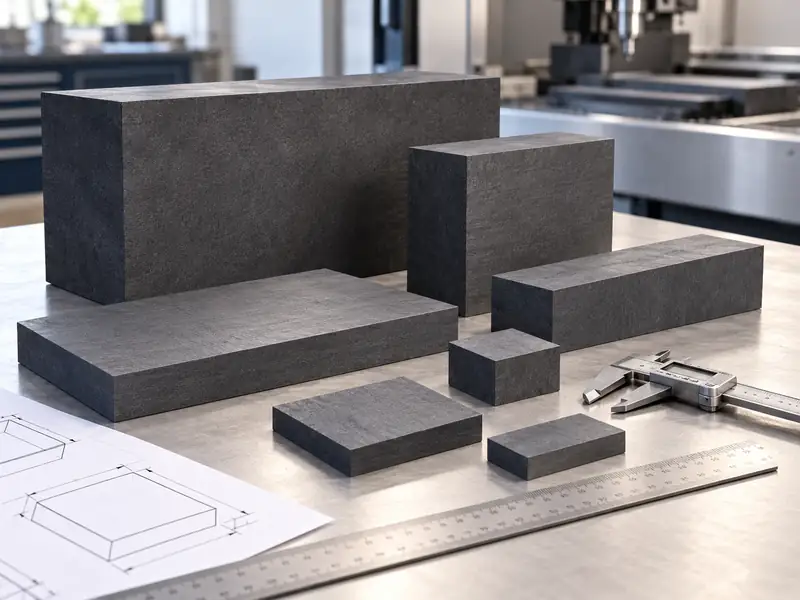
An industrial graphite block is a solid graphite stock shape supplied in a specified material grade for machining, thermal, electrical, or other industrial applications. Buyers typically specify both the block dimensions and material properties because different graphite grades can have substantially different grain structure, density, porosity, strength, and thermal or electrical behavior.

Material Grade + Dimensions (L × W × H) + Application = Complete Graphite Block Specification

Graphite Block vs Carbon Block

Graphite blocks and activated carbon filter blocks are different industrial product categories. This page specifically focuses on graphitized or graphite-rich engineering materials used for structural, thermal, and machining applications, not water filtration or refractory bricks.

Raw Block vs Finished Part

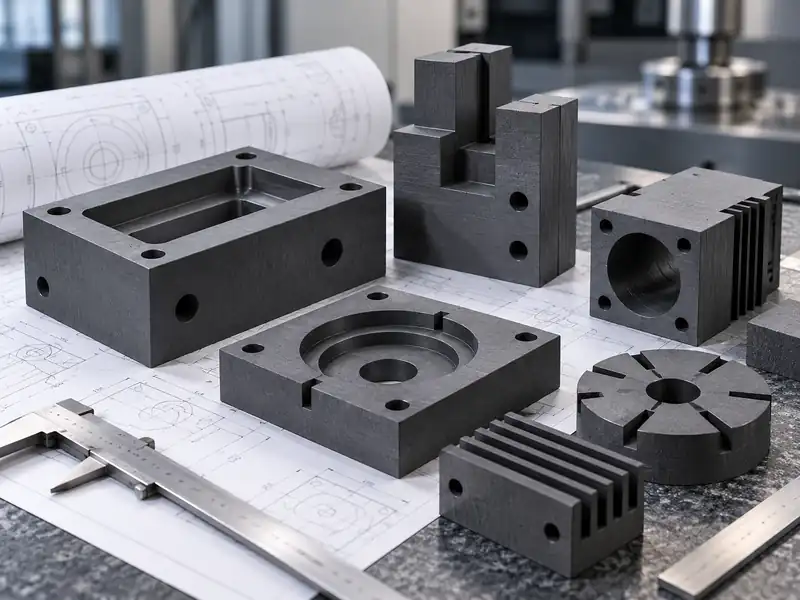
A graphite block is typically the material stock or machining blank. When a graphite block is milled, drilled, or turned into an application-specific geometry (like a mold or bearing), it becomes a finished graphite component.

Graphite block dimensions and material grade specification

Graphite Blocks by Forming Method

Graphite blocks can be classified by the manufacturing process used by the material producer. This forming method influences grain structure, material orientation, and available block sizes.

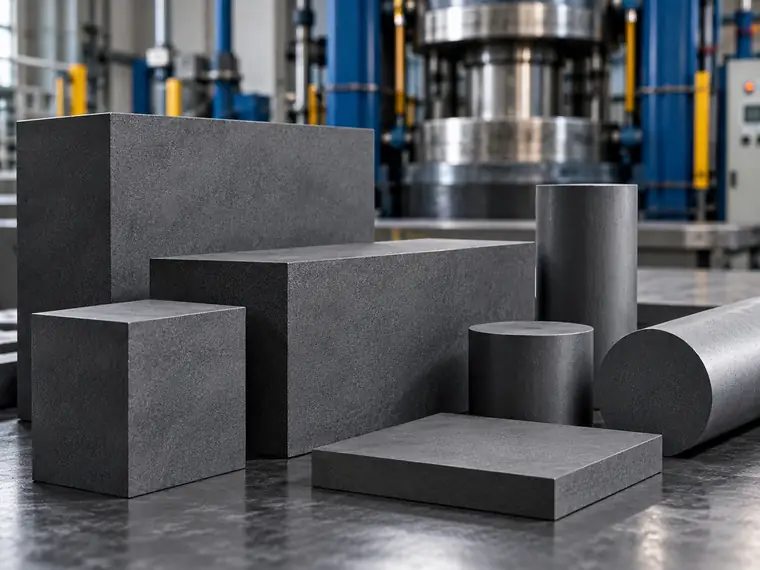
Isostatic graphite block material

Isostatic Graphite Blocks

Isostatic graphite is formed using isostatic pressing. Potential engineering characteristics may include a relatively uniform material structure, fine grain, and reduced directional variation compared with some conventional materials. Exact properties depend on the specific grade.

Ask About Isostatic Grades
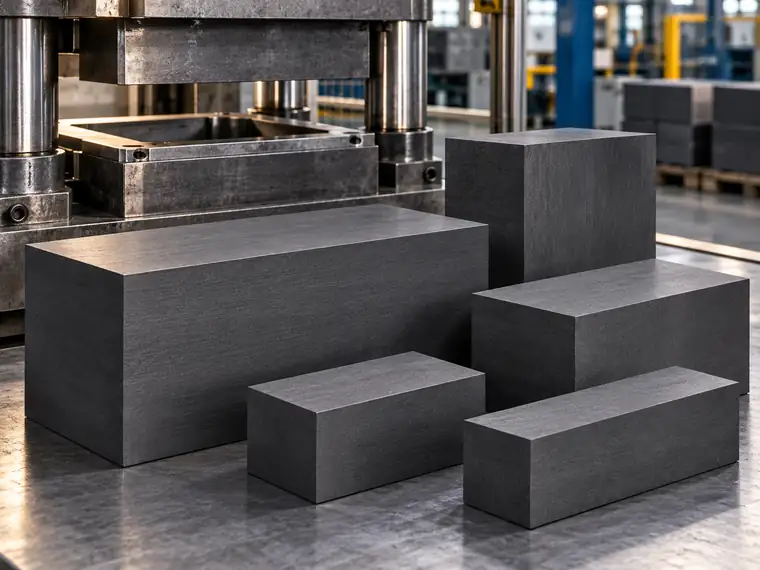
Molded graphite block material

Molded Graphite Blocks

Produced using molding/compression processes. Selection considerations include grain size, block dimensions, material uniformity, and strength. Suitable for various general industrial and machining applications based on grade data.

Ask About Molded Grades
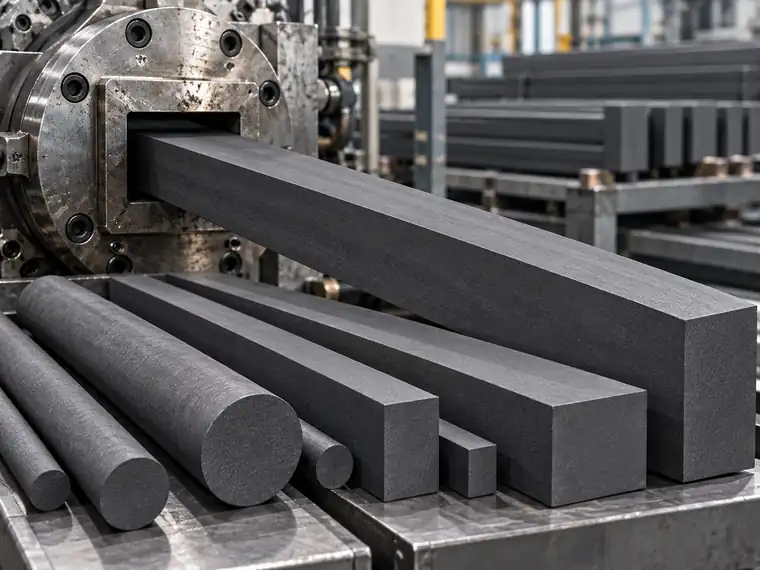
Extruded graphite block material

Extruded Graphite Blocks

Formed through an extrusion process. Extruded material can have directional properties related to the extrusion direction. If material orientation is important for thermal or electrical performance, drawing orientation must be specified.

Ask About Extruded Grades

Fine-Grain vs Medium-Grain Graphite Blocks

Graphite grain size can influence machining detail, surface quality, edge integrity, mechanical behavior, and porosity. We do not invent universal definitions for grain boundaries, as supplier classifications vary. Required grain structure depends on component size and engineering properties.

Factor Fine Grain Medium / Coarser Grain
Fine Detail Machining Often favorable direction Application dependent
Surface Detail Grade dependent Grade dependent
Block Size Availability Grade dependent Grade dependent
Strength & Porosity Grade dependent Grade dependent
Macro view of fine grain vs medium grain graphite block structure

Graphite Block Technical Specifications

A buyer should review verified material properties rather than relying on density or dimensions alone. Properties below are evaluated based on actual CARBOLVE supplied grades.

Parameter Why It Matters for Selection CARBOLVE / Grade Data
Forming Method Influences material structure and orientation [Verified per Grade]
Grain Size Impacts machining detail & structure [Verified per Grade]
Bulk Density General indicator of material structure [Verified per Grade]
Porosity Affects permeability and strength [Verified per Grade]
Ash / Purity Critical for contamination-sensitive processes [Verified per Grade]
Flexural/Compressive Strength Determines mechanical design limits [Verified per Grade]
Electrical Resistivity Required for heating or EDM applications [Verified per Grade]
Thermal Conductivity & CTE Heat transfer and thermal movement [Verified per Grade]

Graphite Block Sizes & Cut-to-Size Service

Available block sizes depend on the selected graphite grade and material source. We do not invent universal stock sizes, as isostatic, extruded, and molded blocks originate in different formats.

Cut-to-Size Specifications

  • Specify Length (L) × Width (W) × Thickness (T/H).
  • Clearly state orientation if material direction matters (e.g., extruded grades).
  • Differentiate between rough Saw-Cut Size and Finished Machined Size (allowance).
Submit Required Dimensions
Measuring length width and thickness of a cut to size graphite block
CNC machining a custom component from a graphite block blank

Custom Machined Graphite Blocks From Your Drawing

A block may be supplied as raw material, a cut blank, semi-finished, or a fully finished component. CARBOLVE provides machining services according to customer drawings.

Operations Milling, Turning, Drilling, Boring, Surface Grinding
Features Grooves, Slots, Pockets, Threads (where verified)

Machining Design Rules

Graphite is highly machinable but relatively brittle. Component design should consider risks associated with thin walls, sharp internal corners, deep small holes, and edge chipping. Machining tolerance depends on material grade, grain structure, and part geometry. Critical dimensions must be clearly identified on the approved drawing.

Upload Your Machining Drawing

Temperature, Atmosphere & Oxidation

Graphite temperature capability depends strongly on atmosphere. Do not assume a single universal maximum temperature for all environments.

Air / Oxygen Environment

Graphite can oxidize in oxygen-containing atmospheres at elevated temperatures. Exposure time, temperature, and material grade dictate the rate of oxidation and material loss.

Vacuum Environment

In a vacuum, suitable graphite grades can operate at significantly higher temperatures without oxidation, often used in vacuum heat treatment furnaces.

Inert Gas Environment

Nitrogen or Argon environments protect graphite from oxidation at extreme temperatures. Always provide both operating temperature and atmosphere when selecting a block.

Graphite Block Applications

Graphite block grade should be selected according to the finished component and application conditions. Below are common industrial directions where verified.

EDM Graphite Blocks

Selection factors include grain structure, density, strength, and electrical properties to balance electrode detail and wear requirement.

Submit EDM Requirements

Molds & Dies

Used for sintering molds, casting molds, and hot-press tooling. Requires review of temperature, pressure, and thermal cycling.

Discuss Mold Material

Furnace Components

High-temperature applications require careful review of atmosphere (vacuum/inert), mechanical load, and oxidation risk.

Submit Furnace Conditions

Metallurgy & Casting

Blocks machined into guides or dies. Requires evaluation of metal type, thermal conductivity, and wear resistance.

Submit Casting Application

Chemical Processing

Chemical compatibility must be confirmed. Ordinary porous block is not impervious process graphite without proper impregnation.

Submit Media Data

General Custom Machining

Supply of semi-finished or finished machined components based on customer drawings and selected graphite grades.

Upload Drawing

Existing Grade Replacement

A known competitor graphite grade can be used as a technical reference, but grade codes are manufacturer-specific. An alternative material should be evaluated using verified property data (forming method, grain, density, strength), block size, component geometry, and operating conditions rather than grade name alone.

Request Graphite Grade Comparison

Common Graphite Block Problems

  • Edge Chipping & Machining Breakout Review material grade, grain size, tool geometry, and thin-wall design. Graphite is brittle.
  • Rapid Oxidation Review operating temperature, oxygen exposure, and atmosphere. Appearance alone does not prove root cause.

How to Choose a Graphite Block

1. Application 2. Forming Method 3. Grain & Properties 4. L × W × H 5. Atmosphere 6. Machining

Do not choose a graphite block from dimensions or density alone. No single graphite grade is best for every application.

What is a graphite block manufacturer?

A graphite block manufacturer may either produce graphite block material from carbon raw materials or process and machine graphite stock into industrial blocks and finished components. Buyers should verify which stages a supplier actually performs, because raw graphite production and finished block machining are different manufacturing capabilities.
Which is better: isostatic or extruded graphite?

Neither is universally better. Isostatic and extruded graphite use different forming methods and can have different grain structures, directional properties, available sizes, and technical characteristics. The correct choice depends on the finished component and operating requirements.

Does higher density mean better graphite?

No. Density is only one graphite property. Grain size, porosity, strength, electrical resistivity, thermal conductivity, thermal expansion, purity, forming method, and block size may also influence material suitability for a specific application.

What is the maximum temperature for a graphite block?

There is no single universal maximum service temperature for graphite blocks. Operating capability depends on the graphite grade, atmosphere, oxygen exposure, time, mechanical load, and application. Graphite behavior in air is significantly different from its behavior in vacuum or inert gas.

Can competitor graphite grades be cross-referenced?

A competitor grade can be used as a technical reference, but grade codes are manufacturer-specific. An alternative should be evaluated using verified material-property data, block size, component geometry, and operating conditions rather than assuming exact equivalence.

What machining tolerances are possible?

Graphite machining tolerance depends on material grade, grain structure, block size, part geometry, feature dimensions, and inspection method. CARBOLVE should quote the actual drawing rather than publish one universal tolerance for all cut or machined blocks.

Request a Quote

Complete material, dimension, and application information helps CARBOLVE confirm graphite availability, suitable grade direction, machining feasibility, and inspection requirements.

What we need to quote:

  • Dimensions (L × W × H) & Quantity
  • Raw Block vs Cut-to-Size vs Machined
  • Material Grade or Required Properties
  • Application & Operating Temperature
  • Engineering Drawing (if machining)

Direct Contact:

sales@carbolve.com

+86(513)-81100106

We will review your requirements and confirm material availability and machining feasibility.