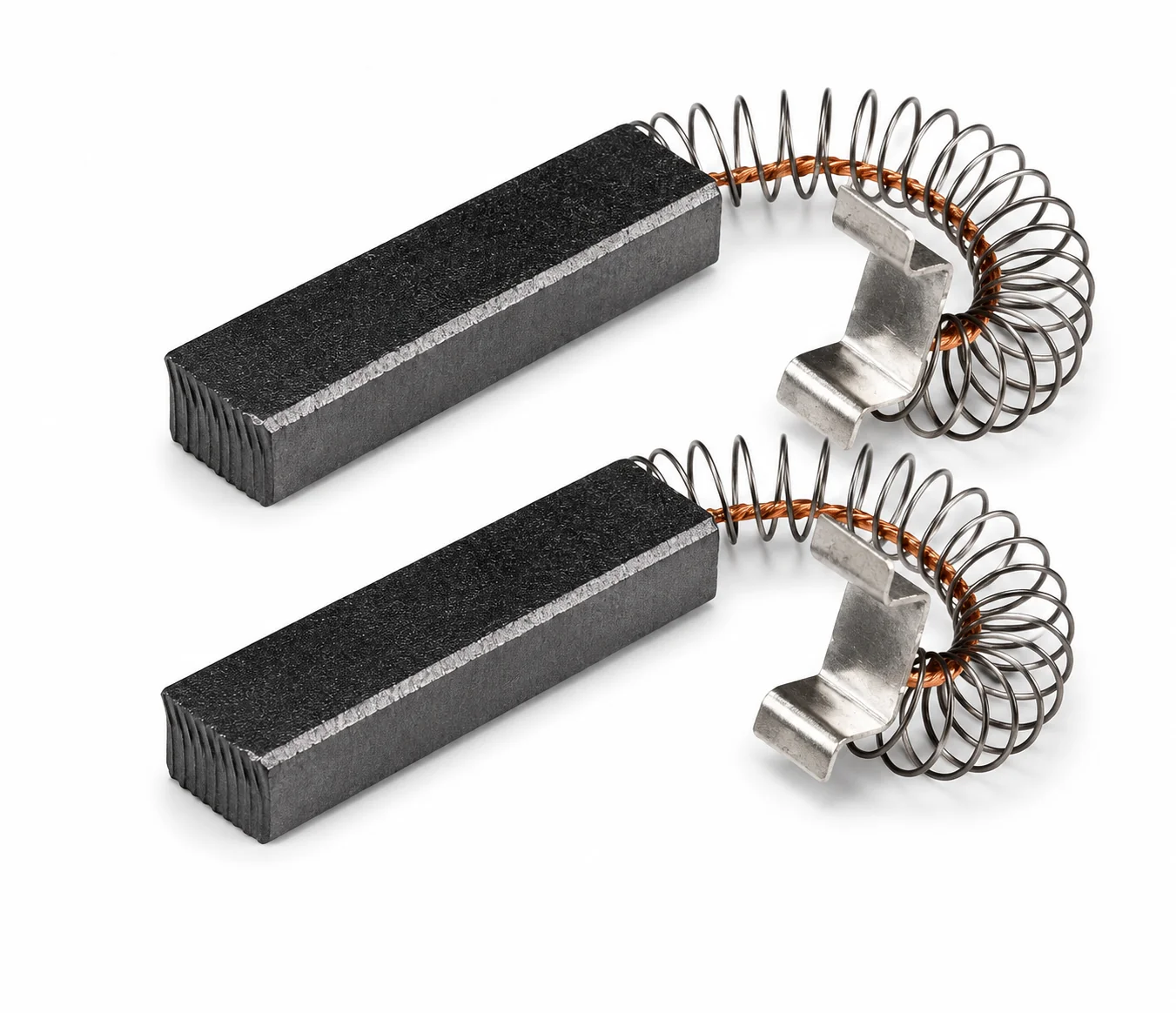
Vacuum Motor Brushes Manufacturer
CARBOLVE manufactures custom, OEM, aftermarket, and replacement vacuum motor brushes for applicable brushed central vacuum motors, household vacuum cleaners, commercial cleaning machines, industrial vacuums, wet/dry equipment, and floor-care systems utilizing high-speed commutators.
Note: Brushless vacuum motors do not use conventional replacement carbon brushes. We support motor model identification, part-number review, and drawing/sample-based production for brushed systems.
- Custom Vacuum Motor Brush Manufacturing
- Motor Model and Sample Evaluation
- Dimensional Inspection Before Shipment
Send the vacuum motor manufacturer, motor model, voltage, brush number, brush dimensions, photographs, commutator information, and required quantity for evaluation.
Carbon & Graphite Products Manufacturer
Vacuum Motor Brush Production
Drawing and Sample Evaluation
Custom Brush Construction
Dimensional Inspection Before Shipment
Vacuum Motor Brushes vs Cleaning Brushes
CARBOLVE vacuum motor brushes are electrical carbon brushes for brushed vacuum motors, not floor-cleaning brushes or vacuum brush rolls.

Vacuum Motor Carbon Brush
An electrical carbon component inside a brushed vacuum motor. It contacts the commutator and transfers motor current.

Vacuum Cleaner Floor Brush
A cleaning accessory used to contact carpets or floors. It is not an electrical carbon brush.

Vacuum Cleaner Brush Roll
A rotating cleaning roller fitted with bristles. It is not the vacuum motor carbon brush.

Motorized Power-Head Brush
A rotating cleaning brush driven by a separate motor. The power-head motor itself may or may not use carbon brushes.
What Are Vacuum Motor Brushes?
A vacuum motor brush is a replaceable carbon or graphite electrical contact used in an applicable brushed vacuum motor. A spring holds the brush against the segmented commutator, allowing current to pass between the stationary electrical circuit and the rotating armature while the motor operates.
Depending on the motor design, components may include the carbon or graphite brush body, contact face, flexible copper lead, terminal, spring, top plate, brush holder, brush cap, wear mark, or cut-off feature where applicable.
How Do Vacuum Motor Carbon Brushes Work?
Electrical current enters the brushed motor circuit.
The brush spring maintains contact between the carbon brush and segmented commutator.
Current passes through the brush and armature circuit according to the motor design.
The commutator mechanically switches the armature current as the rotor turns.
Continuous high-speed sliding contact causes gradual brush and commutator wear.


Brushed vs Brushless Vacuum Motors
Brushed Vacuum Motor
- → Uses carbon brushes
- → Uses brush holders and springs
- → Uses a segmented commutator
- → Includes Universal commutator and brushed DC motors
CARBOLVE vacuum motor brushes may apply.
Brushless Vacuum Motor
- → Electronically commutated (EC/BLDC)
- → Permanent-magnet rotor systems
- → Electronic motor controller
- → No conventional brush commutator
Brushless vacuum motors do not require conventional replacement carbon brushes.
Thru-Flow vs Bypass Vacuum Motors
Thru-flow, bypass, tangential bypass, and peripheral bypass describe vacuum-motor airflow architecture. They do not by themselves identify the correct carbon brush.
Thru-Flow Motor
Working airflow passes through or around the motor to contribute to cooling. Common in household/dry vacuums.
Bypass Motor
Cooling airflow is separated from the working vacuum airflow. Common in central, wet/dry, and commercial equipment.
Tangential Bypass
Bypass vacuum motors using a tangential exhaust discharge arrangement.
Peripheral Bypass
Bypass vacuum motors utilizing peripheral discharge configurations.
Vacuum Motor Brushes vs Carbon Vanes
Vacuum motor brushes and vacuum pump carbon vanes are different products manufactured by CARBOLVE.
| Factor | Vacuum Motor Brush | Carbon Vane |
|---|---|---|
| Equipment | Brushed vacuum motor | Rotary vane vacuum pump |
| Main function | Electrical current transfer | Gas sealing and displacement |
Carbon Brushes for Different Vacuum Motor Applications
The correct vacuum motor brush depends on motor manufacturer, model, voltage, construction, dimensions, material, and commutator. We manufacture for verified brushed systems.

Central Vacuum Motor Brushes
For bypass and thru-flow high-speed commutator systems in central vacuum power units. Model-specific replacements and brush pairs.

Household Vacuum Motor Brushes
Replacement electrical contacts for applicable brushed canister, upright, and bagged vacuum cleaner motors.

Commercial Vacuum Motor Brushes
Engineered for heavy-use cleaning equipment, backpack vacuums, and commercial uprights based on duty-cycle requirements.

Wet/Dry Vacuum Motor Brushes
Carbon brushes for bypass motor designs used in shop vacuum applications. (Brush itself is not suitable for direct water exposure).

Industrial Vacuum Motor Brushes
For verified brushed motors in industrial cleaning and dust collection equipment. Excludes hazardous dust environments unless certified.

Carpet Extractor Brushes
Replacement brushes for suction motors inside carpet extractors, floor-cleaning equipment, and scrubber systems.

Replacement Brush Sets
Identified via existing motor model, brush part number, physical sample, voltage, and terminal specifications.

Custom Vacuum Motor Brushes
Drawing and sample-based production for obsolete products, non-standard dimensions, custom leads, and specific terminals.
Vacuum Motor Brush Supply & Construction Options
Brush, brush pair, brush set, and brush-holder assembly are not interchangeable product descriptions. Every quotation must define exactly what is included. Physical dimensions alone do not make brushes interchangeable.
Materials for Vacuum Motor Carbon Brushes
There is no single carbon brush material suitable for every vacuum motor. Selection depends on motor type, voltage, current, speed, commutator diameter, duty cycle, and environment.
Carbon Graphite
Selected carbon graphite grades may provide an application-specific balance of resistance, mechanical strength, commutation, wear, and contact behavior.
Key Properties Influencing Selection:
- • Electrical resistivity (commutation)
- • Hardness (wear and machining)
- • Flexural strength (compact sections)
Electrographite
Selected electrographite grades may be considered for high-speed or demanding commutator motor applications where electrical, thermal, mechanical, and wear characteristics must be balanced.
Note: Electrographite is not automatically the correct material for every vacuum motor. Final selection requires motor evaluation.
Custom Vacuum Motor Brush Specifications
Dimensions alone may not identify the correct brush material. A worn brush may not show its original length.
Brush Body Dimensions
| Thickness & Width | Drawing, sample, or holder dimension |
| Length | Confirm original/unworn dimension |
| Contact Face | Flat, radiused, curved, beveled, custom |
Lead and Terminal
| Lead Position | Centered, offset, top, or side |
| Terminal Type | Eyelet, tab, plate, spade, fork, ring |
How to Measure a Vacuum Motor Carbon Brush
- 1. Thickness: Measure dimension fitting between holder guides.
- 2. Width: Measure the second cross-sectional dimension.
- 3. Length: Measure complete body length (note if worn).
- 4. Holder: Measure internal thickness/width.
- 5. Marking: Photograph all visible brush codes.
How to Identify a Replacement Vacuum Motor Brush
By Motor Model
Provide motor manufacturer, complete motor number, and voltage. (Preferred route)
By OEM Brush Number
Provide original brush number, set number, or holder number for verification.
By Dimensions
Provide thickness, width, original length, contact face, lead, terminal, and spring.
By Physical Sample
Used when original info is unavailable. Helps identify geometry but may hide original length.
Motor-Model and Part-Number Review Policy
A motor number is generally more useful than the outer vacuum-cleaner housing model when identifying the motor carbon brush. CARBOLVE follows a strict workflow:
- Identify supplied number
- Confirm exact motor version
- Check motor voltage
- Review existing brush
- Compare dimensions
- Compare spring/terminal
- Review material requirements
- Confirm commutator face
- Prepare CARBOLVE drawing
- Validate samples
Commutator Information for Brush Selection
A replacement carbon brush should be evaluated together with the commutator. Installing a new brush on a severely damaged commutator may result in rapid brush wear or unstable motor operation.

Normal Surface
Even, stable running surface.

Grooving
Review pressure, contamination, wear.

Heavy Scoring
Brush worn too far or hard debris.

Burning
Review sparking, heat, electrical load.

Carbon Deposits
Review material and motor condition.
Visible commutator damage should be evaluated before specifying only a replacement brush.
Vacuum Motor Brush Troubleshooting Guide
Vacuum motor symptoms may also originate from the motor winding, armature, bearings, fan, switch, or blocked airflow. Replacing the carbon brushes alone may not correct the root cause.
| Symptom | Possible Contributing Factors | Information to Check |
|---|---|---|
| Motor will not start | Brushes, switch, relay, thermal protection, wiring, armature or field | Complete motor circuit |
| Intermittent operation | Brush wear, sticking, weak spring, lead or commutator contamination | Brush movement and connections |
| Excessive sparking | Worn brush, incorrect material, poor seating, damaged commutator, overload | Brush face and commutator |
| Rapid brush wear | Incorrect material, high speed, rough commutator, excessive pressure, dust | Wear pattern and operating data |
| Brush sticking | Incorrect dimensions, rough sides, carbon dust, heat, holder deformation | Brush and holder dimensions |
| Reduced suction | Reduced motor speed, filters, hose blockage, air leaks, fan damage | Vacuum system and motor |
Why Work With CARBOLVE for Vacuum Motor Brushes?
We specialize in carbon brush manufacturing, offering OEM and aftermarket support with strict dimensional and assembly inspection.
1. Motor & Sample Evaluation
We evaluate motor models, brush numbers, drawings, samples, dimensions, and operating information to determine the correct specification.
2. Custom Construction Support
Depending on verified capability, we evaluate brush dimensions, contact faces, flexible leads, terminals, springs, and holders.
3. Repeat-Order Control
Approved drawings, samples, material references, dimensions, and inspection requirements are retained according to our procedures.
Manufacturing & Quality Control Process
-
Precision Machining: Thickness, width, length, contact radius, and custom geometry.
-
Assembly: Lead installation, terminal assembly, and spring assembly where verified.
-
Dimensional Inspection: Checking against approved drawing or sample tolerances.
-
Surface & Assembly Check: Inspecting for cracks, chips, lead position, and terminal orientation.


Custom Vacuum Motor Brush Solutions
Case 1: Central Vacuum Motor Brush Pair
- Motor Type: Bypass central vacuum motor
- Replacement Requirement: Matched pair based on OEM number
- Verified Result: Dimensional fit confirmed, correct terminal orientation supplied.
Case 2: Commercial Vacuum Motor Brush
[Insert verified CARBOLVE application case regarding commercial vacuum duty cycle and material selection.]
Case 3: Obsolete Vacuum Motor Brush
- Motor Info: Legacy household vacuum
- Challenge: Missing OEM info, heavily worn sample
- Verified Result: Original length estimated from holder, custom drawing approved, sample validated.
Case 4: Custom Brush With Spring
[Insert verified CARBOLVE application case regarding specific spring force and terminal integration.]
Frequently Asked Questions
Do all vacuum motors use carbon brushes?
Can two vacuum motor brushes with the same dimensions be different?
Can motor voltage affect brush compatibility?
Can worn brushes cause reduced suction?
Does replacing carbon brushes always repair a vacuum motor?
When should vacuum motor brushes be replaced?
What is the difference between a vacuum motor brush and a floor brush?
What Information Is Needed for a Quote?
Not every item is required for every inquiry. Provide all information currently available to help us evaluate compatibility and manufacturing feasibility.
- Motor manufacturer & model
- Motor voltage & rated power
- Existing brush number
- Brush thickness × width × length
- Spring & terminal dimensions
- Commutator condition
- Required prototype/order quantity
- Clear photographs or drawing