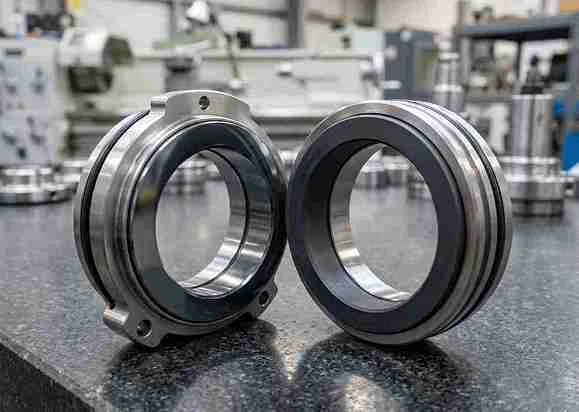
Custom Graphite Parts Manufacturer
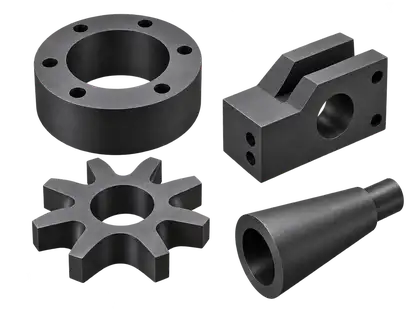
CARBOLVE manufactures custom graphite parts according to drawings, physical samples, material requirements and operating conditions for industrial OEM, replacement and maintenance projects.
Material grade, part geometry and operating conditions should be reviewed together before manufacturing a custom graphite component.
- Drawing & Sample Manufacturing
- Graphite Material Review
- Custom CNC Machining
- OEM & Replacement Parts
Send your drawing, sample, material grade if known, dimensions, critical tolerances, application, operating temperature, atmosphere and quantity.
How Would You Like to Start Your Custom Graphite Part Project?
I Have a Drawing
PDF, DWG, or DXF containing geometry and tolerances.
I Have a CAD / STEP Model
3D geometry requiring material and tolerance definition.
I Have a Physical Sample
New or used graphite component for measurement.
I Have a Worn or Broken Part
Fragments or worn parts requiring geometry recovery.
I Have an OEM Reference
Equipment model or existing part number.
I Know the Dimensions
Basic OD, ID, length, and functional features.
I Only Know the Application
Operating temperature, load, and atmosphere data.
I Need a Replacement Part
Reproducing an existing or obsolete graphite component.
You do not need to know every parameter before contacting CARBOLVE. Send the information currently available and additional technical requirements can be identified during review.
Standard Graphite Product vs Custom Graphite Part
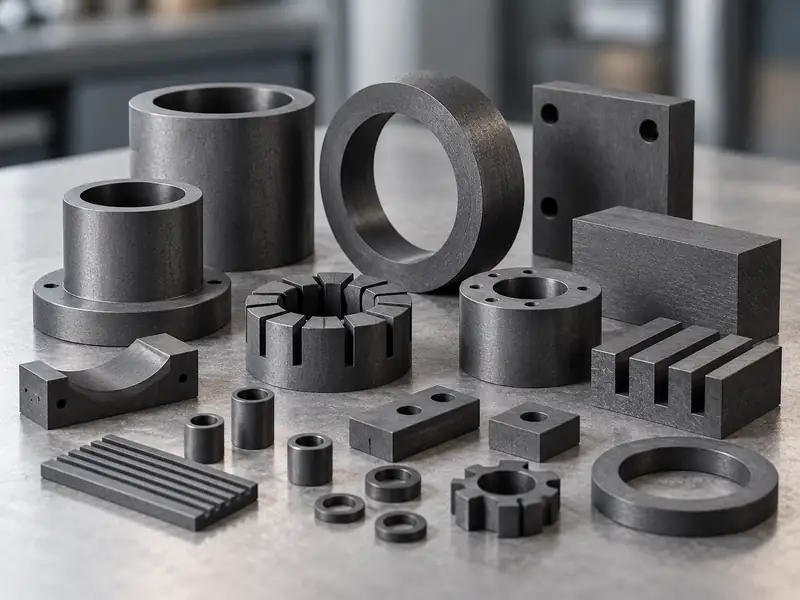
A custom graphite part is a graphite component manufactured to a customer-specific geometry, material specification and application requirement rather than supplied only as a standard stock shape. Custom manufacturing begins when the customer’s geometry, material or operating requirements cannot be satisfied by a standard graphite product.
Standard Graphite Product
- Existing shape
- Existing size
- Existing material
- Catalog configuration
Custom Graphite Part
- Customer drawing
- Custom dimensions & features
- Specific material grade
- Application-specific tolerances
Graphite Stock Material vs Finished Graphite Component
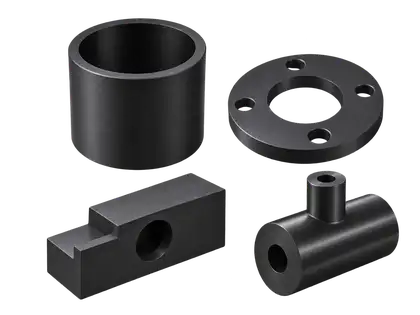
Graphite stock and custom graphite components are different purchasing requirements: one is primarily material-focused, while the other is component- and drawing-focused. Raw graphite material production and finished custom graphite machining are different manufacturing capabilities.
Graphite Stock Material
Material blanks or semi-finished forms supplied for further machining.
- Graphite Block
- Graphite Plate
- Graphite Rod
- Graphite Tube
Finished Custom Graphite Part
A graphite blank machined to a controlled application-specific geometry.
- Bores and Holes
- Grooves, Slots, and Pockets
- Machined Threads
- Radii, Chamfers, and Custom Profiles
How to Select a Graphite Material for a Custom Part
No single graphite grade is best for every custom component. Graphite material selection should use the complete grade specification rather than density or color alone. Do not mix different material attributes into one taxonomy.
Forming Method
Isostatic graphite refers to material formed using an isostatic pressing process. Extruded graphite is produced using an extrusion forming process.
- Isostatically Pressed
- Extruded
- Molded / Vibration-Molded
Grain Structure
Fine grain can be useful for detailed machining, but grain category alone does not define the complete graphite grade.
- Fine Grain
- Medium Grain
- Coarser Grain
Material Properties
Density and porosity are separate technical properties and should be evaluated together with strength and thermal characteristics.
- Density & Porosity
- Electrical Resistivity
- Thermal Conductivity & CTE
Does Graphite Material Orientation Matter?
Some graphite materials, particularly extruded grades, can have directional properties affecting electrical resistivity, thermal conductivity, thermal expansion, and mechanical strength. For sensitive parts, request orientation information relative to mechanical load, heat flow, or current direction.
Operating Conditions: Temperature & Atmosphere
A graphite part’s operating-temperature specification is incomplete without the operating atmosphere. Temperature capability depends on the graphite grade, atmosphere, oxygen exposure, process gas, mechanical load, component geometry, and exposure time.
Graphite Oxidation
Graphite may oxidize in oxygen-containing environments at elevated temperature. Potential effects include material loss, wall thinning, edge loss, surface erosion, dimensional change, and reduced component life. High-temperature graphite performance should always be evaluated together with atmosphere.

Design for Manufacturability of Custom Graphite Parts
Graphite is highly machinable but relatively brittle compared with ductile metals. A design that is easy to manufacture in metal may require modification when machined from brittle graphite.
Can Graphite Parts Have Thin Walls?
Yes, some graphite components can be machined with relatively thin sections, but feasibility depends on graphite grade, part size, wall length, geometry, machining method, handling and application load.
Holes & Bores
Review hole diameter, depth, aspect ratio, remaining wall, position, concentricity, and edge distance. There is no universal minimum hole diameter for all graphite parts.
Can Threads Be Machined in Graphite?
Threads can be machined in suitable graphite components when material grade, wall thickness, thread size, engagement and loading allow. Do not assume metal-equivalent thread strength.
Sharp Corners, Radii & Edge Design
Sharp features may increase stress concentration, edge chipping risk, and machining difficulty. Where function permits, a radius or chamfer may help.
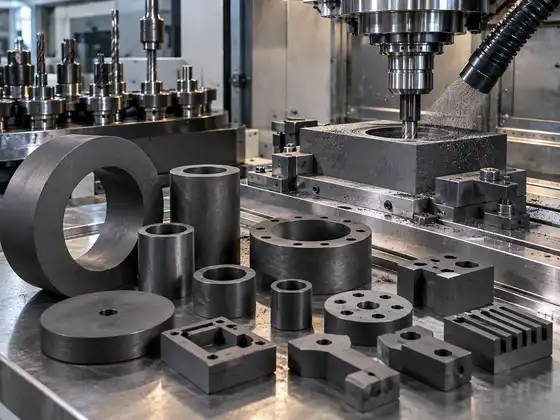
How CARBOLVE Manufactures Custom Graphite Parts
Finished graphite component machining involves verifying material specifications, selecting graphite blanks, and executing controlled CNC processes.
- CNC Turning: Machining rings, sleeves, bushings, discs, and cylindrical components. Controlling OD, ID, length, steps, and grooves.
- CNC Milling: Machining flat surfaces, pockets, slots, channels, bolt patterns, and complex profiles.
- Drilling & Boring: Creating through holes, blind holes, center bores, and counterbores to required depths and positions.
- Grinding & Lapping: Achieving precision thickness, flatness, parallelism, and specific surface requirements where necessary.
Custom Graphite Machining Tolerances
Tolerance depends on material grade, grain structure, part dimensions, wall thickness, feature geometry, machining operation, and inspection method. CARBOLVE should evaluate tolerances from the actual drawing rather than apply one tolerance to every custom graphite part. Not every dimension needs the same tolerance. Critical functional dimensions should be identified clearly.
Manufacturing Workflows: Drawings, Samples & CAD
What Should a Custom Graphite Drawing Include?
- Drawing number and revision
- Units and datums
- Material grade
- Dimensions and tolerances
- Critical features and surface requirements
- Inspection notes
Custom Graphite Parts From CAD Files
CARBOLVE accepts STEP, STP, IGES, IGS, DWG, and DXF files. CAD geometry does not replace material and application information. Ask for drawing revision, units, material grade, critical tolerances, and application data.
Custom Graphite Parts From a Physical Sample
A physical sample can provide geometry but does not automatically identify the exact graphite grade. A worn graphite part is an identification reference, not necessarily a complete original manufacturing specification.
OEM, Replacement & Obsolete Parts
Custom Graphite Parts for OEM Equipment
Provide component function, equipment, drawing, material, load, temperature, atmosphere, electrical requirements, and quantity. Flow: Application → Material → Geometry → DFM → Prototype → Customer Validation → Approved Specification → Repeat Production.
Replacement Graphite Parts
An OEM or third-party part number may be used for identification, but final specifications should be technically verified. Identification methods include drawing, existing part number, equipment model, new sample, worn sample, broken sample, dimensions, or photos.
Custom Graphite Parts for Obsolete Equipment
Workflow: Obsolete Equipment → Existing Part / Fragments → Equipment Data → Original References → Geometry Recovery → Material Review → Proposed Drawing → Prototype → Production.
Quality Control & Packaging
Material Verification
Checking material grade, manufacturer reference, material data sheet, or certificate.
Functional Geometry
Inspecting OD, ID, thickness, length, hole position, grooves, and threads.
Geometric Inspection
Where required: flatness, roundness, concentricity, and parallelism.
Surface Inspection
Looking for cracks, chips, edge damage, surface defects, and contamination.
Protecting Custom Graphite Parts During Export
Graphite components can be vulnerable to edge impact, chipping, component-to-component contact, abrasion, bending of long/slender parts, and contamination. Verified packaging approaches include individual separation, protective inserts, foam, custom trays, reinforced cartons, and wooden cases.
Custom Graphite Part Failure Analysis — What Should Be Checked?
Visual failure appearance alone does not establish root cause. Premature graphite wear should be investigated as a system issue rather than attributed automatically to material quality.
Cracking / Chipping
Review impact, thin sections, sharp stress concentration, installation force, clamping, mechanical overload, thermal shock, material grade, and shipping damage.
Premature Wear
Review incorrect material grade, mating surface, speed, load, alignment, abrasive particles, temperature, humidity, process gas, and lubrication condition.
Oxidation Damage
Review oxygen-containing atmosphere, temperature, time, air leaks, surface area, and grade.
What Information Is Needed for a Custom Graphite Parts Quote?
Project Starting Point
- Engineering Drawing
- CAD / STEP
- Physical Sample
- OEM Reference
- Dimensions Only
- Application Only
Material & Geometry
- Existing Grade
- Forming Method & Grain
- Length, Width, Height
- OD, ID, Thickness
- Holes, Grooves, Threads
- Critical Tolerances
Operating Conditions
- Temperature
- Atmosphere / Vacuum
- Load & Speed
- Process Media
- Electrical Requirement
- Thermal Requirement
Commercial
- Project Type (OEM, Repeat)
- Prototype Quantity
- Production Quantity
- Annual Demand
- Destination
- Inspection Requirements
Not every field is required for every custom graphite part. Send all available information and CARBOLVE can identify additional data required during technical review.