Replacement Carbon Brushes for Motors & Generators
CARBOLVE evaluates and manufactures replacement carbon brushes from existing OEM part numbers, brush markings, technical drawings, physical samples, and machine operating data. A matching external size alone does not confirm carbon brush compatibility. We verify materials, dimensions, contact faces, shunts, and terminals for electric motors, DC/AC systems, generators, alternators, and slip-ring assemblies.
Send the existing part number, brush marking, T × W × L dimensions, machine manufacturer/model, photographs, sample, and quantity.

Find Your Replacement Carbon Brush
Select the information you currently have to begin the identification process.
Search by Part Number
Search by Motor / Generator
Search by Motor / Generator
Search by Brush Grade
Upload Brush Photos
Provide clear photos of all sides, contact face, shunt, terminal, and markings.
Send a Physical Sample
Physical samples are highly recommended for comprehensive dimensional and material review.
Replacement Carbon Brushes by Requirement
CARBOLVE supports diverse industrial procurement scenarios, from direct OEM part number cross-referencing to reverse-engineering obsolete brush samples.

OEM Reference Replacement
For buyers with an existing OEM part number or existing brush reference code.

Sample-Based Replacement
For buyers with a physical new or worn carbon brush available for inspection.

Drawing-Based Replacement
For buyers possessing existing OEM or custom technical drawings.
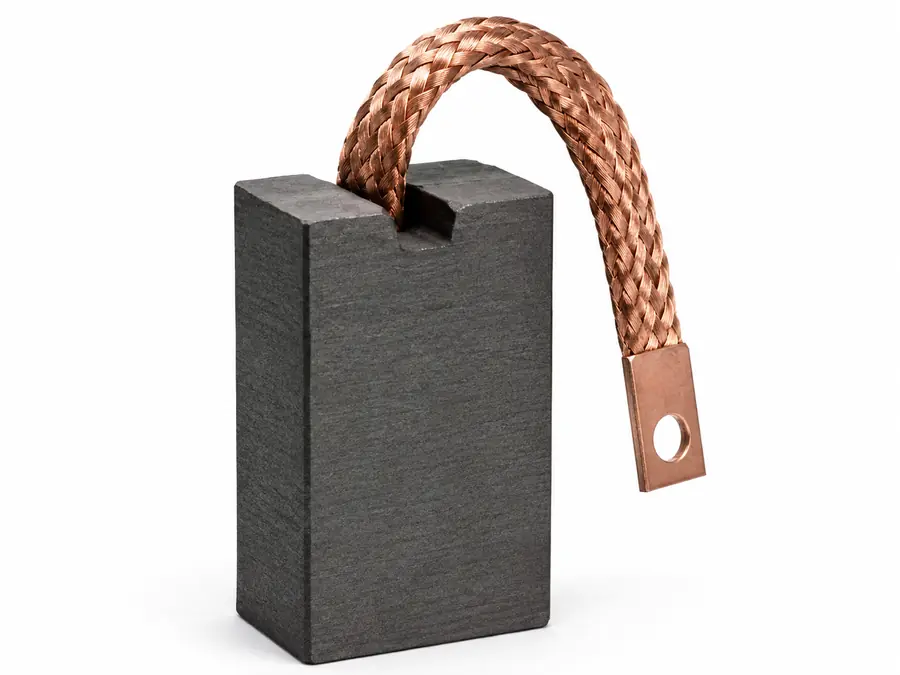
Obsolete Brush Replacement
For discontinued or difficult-to-source products requiring substitute engineering.
What Are Replacement Carbon Brushes?
Replacement carbon brushes are carbon or graphite electrical contacts selected or manufactured to replace worn, damaged, obsolete, or unavailable brushes in existing motors, generators, slip-ring systems, and other brushed electrical machines.
A reliable replacement specification must consider more than external size. It includes evaluating the material grade, dimensions (thickness, width, original length), contact-face geometry, shunt quantity and position, terminals, spring mechanism, and the specific operating environment of the machine.
How to Identify the Right Replacement
The strongest replacement evaluation normally combines several information sources:
- Complete original part number or OEM drawing
- Existing carbon brush material grade
- Motor/generator manufacturer and specific model
- Physical sample (new or worn) with clear photographs

Detailed Identification Methods
Depending on what you have available, CARBOLVE utilizes different technical evaluation paths.
Find by Part Number
A complete OEM part number, existing brush number, or supplier code is often the fastest starting point. However, number formats change, and third-party codes should not automatically be interpreted as exact equivalents without verification.
Identify by Machine
Provide the equipment manufacturer, motor/generator model, serial number, and a clear photograph of the machine nameplate. This context is critical when part numbers are missing.
Find by Dimensions
Measure Thickness (T) × Width (W) × Length (L). Note any bevels, grooves, or specific shunt/terminal arrangements. Warning: Matching dimensions does not prove material equivalence.
Identify by Material Grade
Grade codes are manufacturer-specific. A third-party grade marking on the brush body should be treated as a technical reference rather than automatic proof of exact material equivalence.
From a Physical Sample
A physical sample allows inspection of geometry, contact face, shunts, terminals, and wear patterns. It provides valuable data, but machine operating data may still be required for final specification.
Identify from Photos
Photographs are useful for initial identification but may not be sufficient for a complete specification. Send clear photos of all sides, contact face, shunts, terminals, and the brush holder.
Replacement Brushes by Application

DC Motor Brushes

AC Motor Brushes
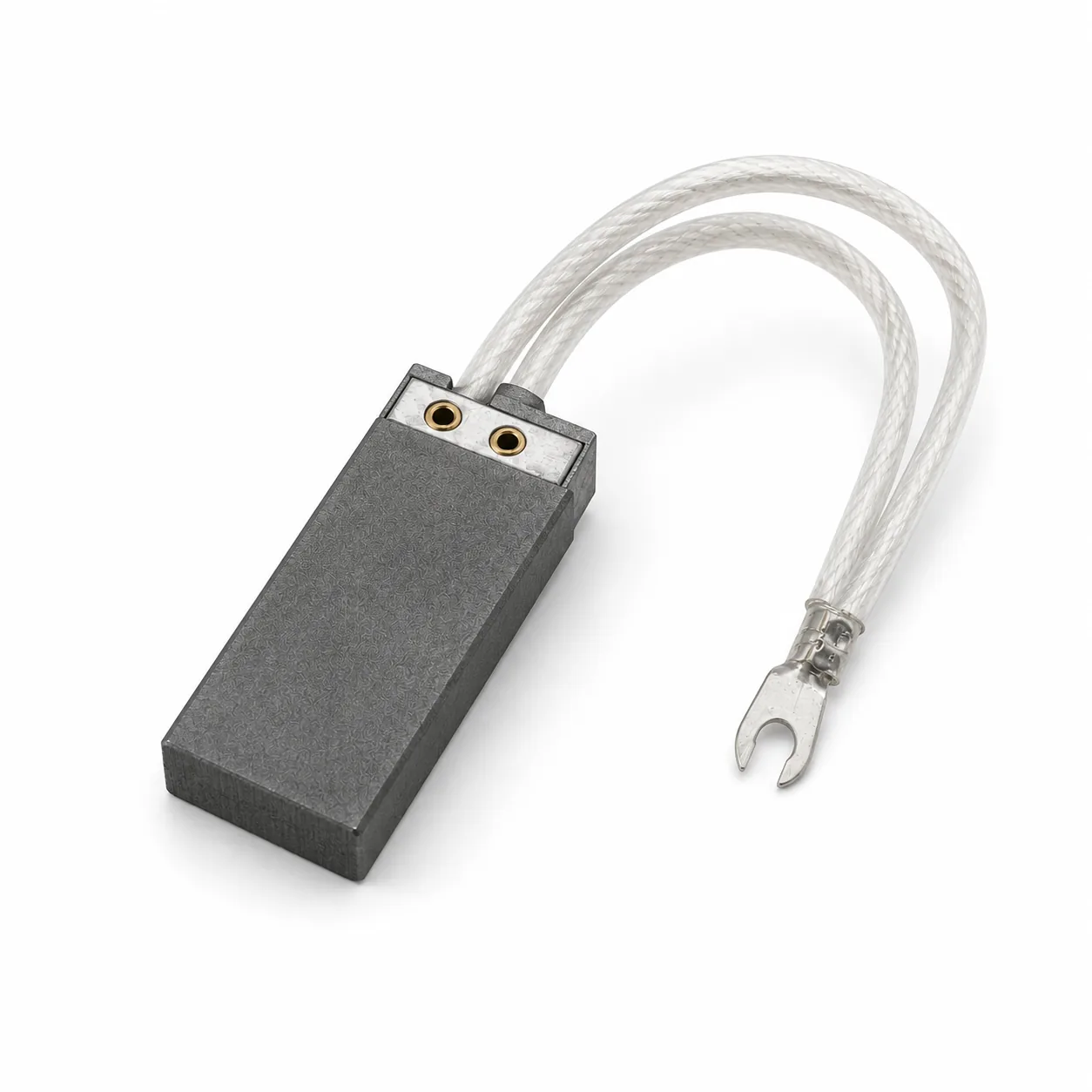
Industrial Brushes

Generator Brushes

Alternator Brushes

Slip Ring Brushes

Power Tool Brushes

Vacuum Motor Brushes
By Material
Replacement material should not be selected only from brush color or appearance.
By Construction
How to Measure a Carbon Brush for Replacement
Worn length should not automatically be treated as original brush length. Always specify measuring reference points.
Required Dimensions
- T Thickness: The dimension perpendicular to the commutator or slip ring rotation.
- W Width: The dimension parallel to the axis of rotation.
- L Length: The dimension in the direction of brush feed. State if new or worn.
Contact Face
Identify if the face is flat, concave radius, beveled, angled, or grooved. This depends on commutator/slip-ring diameter and brush angle.

Identify the Shunt
Record number of shunts, entry/exit positions, length, cross-section, and insulation. Two similar brushes can have different shunts.

Terminal & Spring
Identify terminal style (ring, fork, flag, spade) and orientation. A replacement cannot compensate for a damaged holder or incorrect spring.

Engineering Review for Replacements
Matching dimensions while changing to an inappropriate material can lead to different electrical and mechanical behavior.
Machine Information Required
| Parameter | Why It Matters for Replacement |
|---|---|
| Voltage & Current | Defines electrical loading and resistivity requirements. |
| RPM / Diameter | Determines peripheral speed capability. |
| Commutator vs Slip Ring | Commutators require commutation properties; slip rings require continuous transfer. |
| Duty Cycle | Impacts wear, heat generation, and material selection. |
| Operating Environment | Temperature, humidity, dust, and chemicals affect contact film formation. |
Commutator or Slip Ring?
Do not select a replacement grade for a slip ring simply because it has the same dimensions as a commutator brush. Commutators are segmented for current transfer and commutation (DC/universal), while slip rings are continuous (wound-rotor/generators).
Operating Environment
If operating conditions (low humidity, oil mist, high altitude, frequent starting) have changed since the original brush was selected, reproducing original physical dimensions may not solve current performance problems.
New Sample vs. Worn Sample
A worn carbon brush is an identification reference, not necessarily a complete engineering specification.
| Information | New Sample | Worn Sample |
|---|---|---|
| Original Length | Available | Uncertain |
| Contact Face | Representative | Changed |
| Markings | Clear | May be worn |
| Wear Behavior | Not shown | Useful diagnostic |
OEM, Aftermarket & Obsolete
OEM vs Aftermarket Replacement
An OEM brush is supplied to original machine specs. An aftermarket replacement is produced by a manufacturer like CARBOLVE to a verified replacement specification. We do not claim 100% equivalent without verified evidence.
Original Grade vs Substitute Grade
Grade substitution should be treated as an engineering change. If the original grade is unavailable, we review operating conditions to select a candidate replacement grade for validation.
Stock vs Made-to-Order
Standard stock applies where a verified specification exists. Made-to-order is required for obsolete products, non-standard dimensions, or special shunt/terminal requirements.
Common Replacement Challenges
OEM Number Cannot Be Found
Provide machine model, photos, dimensions, and a physical sample for reverse-identification.
Original Manufacturer Discontinued
CARBOLVE evaluates obsolete replacement development based on remaining data and machine specs.
Replacement Fits but Wears Fast
Check for wrong grade, incorrect pressure, damaged surface, or changed operating environment.
Different Suppliers, Different Codes
Use technical data and operating parameters, not just code names, to establish material equivalence.
Shunt Is Too Short / Long
Always specify measurement reference points (e.g., from top of brush to center of terminal hole).
Terminal Does Not Fit
Check terminal geometry, opening size, and orientation relative to the brush body.
CARBOLVE Replacement Workflow
How we move from unknown sample to controlled repeat production.
Sample-Based Development
Validation is critical when the original grade is unknown, the brush is obsolete, or operating conditions have changed. Customer validation typically involves checking holder fit, terminal installation, and operational performance (wear, sparking, temperature).
Quality Control
- Dimensional inspection (T, W, L, Radius)
- Construction (Shunt length, terminal)
- Surface check (Cracks, chips, edges)
- Material reference verification
Maintenance & Troubleshooting
Carbon brush problems can originate from the brush holder, spring, commutator, slip ring, vibration, or contamination.
When Should Carbon Brushes Be Replaced?
Carbon brushes should be replaced according to the machine manufacturer’s wear criteria, approved maintenance specification, or verified remaining-length requirement rather than one universal brush length. Indicators include reaching the wear mark, broken shunts, heat damage, or severe contact damage.
Should All Brushes Be Replaced Together?
In multi-brush systems, inspect the complete set. Replacing a matched set may be appropriate depending on wear variation and current distribution. Do not mix unverified material grades within the same brush system without technical approval.
| Symptom | Possible Contributing Factors | Check |
|---|---|---|
| Rapid wear | Grade, speed, pressure, surface, contamination | Brush + machine |
| Sparking | Brush, holder, spring, commutator, electrical fault | Complete system |
| Uneven wear | Pressure, alignment, runout, current sharing | Full set |
| Brush sticking | Dimensions, dust, oil, heat | Holder |
| Hot shunt / terminal | Current overload, loose connection, corrosion | Shunt / Terminal |
Evaluate CARBOLVE With Verified Manufacturing Evidence
Product Evidence
- • Replacement brush samples
- • Different constructions
- • Finished brush sets

Manufacturing Evidence
- • Precision machining
- • Shunt installation
- • Terminal assembly

Inspection Evidence
- • Dimensional inspection
- • Contact radius check
- • Material verification

Frequently Asked Questions
Technical answers regarding replacement carbon brush identification and specification.
Can I find a replacement carbon brush by dimensions?
Can two brushes with the same dimensions be different?
Can a worn carbon brush be used as a sample?
Are carbon brush grade numbers universal?
Does a new carbon brush always stop sparking?
Should carbon brushes be replaced as a set?
What Information Is Needed?
Not every item is required for every inquiry. Send all information currently available.
Identification
OEM number, grade, machine manufacturer, model, nameplate.
Brush Details
Drawing, photos, sample, T × W × L (note if worn), contact face, shunts, terminal.
Electrical & Mechanical
Voltage, current, RPM, number of brushes, duty, reversing.
Commercial
Quantity required, destination, packaging requirements.