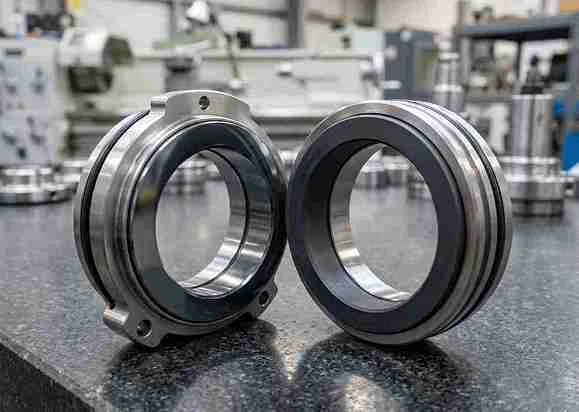

Custom Metal Impregnated Carbon Seals
CARBOLVE precision-machines metal-impregnated carbon graphite seal faces and rings to approved drawings and material specifications. Each project is reviewed against the process medium, temperature, pressure, speed, lubrication condition, mating face and functional geometry before the material direction is confirmed.
Metal-Impregnated Carbon Components We Supply
This page covers finished carbon and carbon-graphite sealing components manufactured to an approved component drawing and material specification. It does not represent a complete mechanical seal assembly unless the additional system components are separately confirmed.

Mechanical Seal Faces
Flat or profiled carbon faces for axial end-face sealing against an approved mating face. Critical requirements may include OD, ID, thickness, face width, flatness, surface finish, grooves and drive features.
Solid Carbon Seal Rings
One-piece rings machined to the required profile, dimensions and functional features for the verified seal design.
Segmented Carbon Ring Sets
Matched multi-segment rings for circumferential shaft sealing. Segment count, joint geometry, assembled dimensions, spring grooves and running clearance must follow the approved design.
Rotary & Stationary Carbon Faces
Carbon components manufactured for seal systems in which the carbon face rotates or remains stationary. The mating material and loading arrangement remain part of the complete seal specification.
Metal Impregnation Directions for Engineering Review
Metal type is only one part of a mechanical carbon specification. The impregnant must be evaluated together with the base carbon grade, process medium, lubrication condition, mating face and operating duty. The directions below are preliminary selection paths, not universal temperature or pressure ratings.

Swipe horizontally to view the full matrix →
| Impregnation Direction | Typical Selection Context | What Must Be Verified |
|---|---|---|
| Antimony | Demanding seal faces, low-viscosity fluids and applications where stiffness or blister resistance is an important selection factor | Base carbon grade, process medium, regulatory restrictions, temperature, pressure, speed and counterface |
| Copper | Applications where modified heat-transfer behavior and mechanical loading are important | Fluid compatibility, corrosion risk, temperature, load, geometry and approved material data |
| Babbitt | Selected lubricated or submerged duties where the alloy’s friction and running behavior may be useful | Exact alloy, medium, lubrication, temperature and component loading |
| Bronze | Selected heavy-duty wet-running mechanical carbon applications | Bronze composition, media compatibility, speed, load and wear validation |
| Nickel Alloy / Nickel-Chrome | Specialized applications requiring a high-strength or wear-oriented metallized-carbon direction | Alloy chemistry, fluid-film condition, corrosion compatibility, temperature and application qualification |
Note: No metal impregnation is universally superior. If the medium is chemically aggressive, regulated for product contact, abrasive, or incompatible with the selected metal, a resin-impregnated, all-carbon or hard-face alternative may be more appropriate.
Why Material Name Alone Is Not Enough
A Black Ring Looks Like the Original
Color and appearance cannot identify the exact carbon family, impregnation, strength, thermal behavior or operating limits. Start with the original grade, drawing, equipment information and service conditions whenever available.
A Grade Is Chosen from Temperature Alone
A temperature value without atmosphere, duration, pressure, fluid, speed and thermal cycling can be misleading. The complete duty must be reviewed before a material is approved.
The Replacement Fits but Leaks or Wears
Matching OD, ID and thickness does not confirm face flatness, running clearance, joint geometry, mating material or lubrication behavior. A dimensional match is only one part of replacement verification.
A Third-Party Grade Is Matched by One Property
Density or hardness alone cannot establish equivalence. Base carbon structure, impregnation, strength, modulus, thermal expansion, conductivity, porosity, chemical compatibility and seal design may all affect suitability.
Metal, Resin, Unimpregnated Carbon and Ceramic: Different Roles

Swipe horizontally to view the full comparison →
| Material Direction | What Changes | Common Decision Context | Main Limitation to Check |
|---|---|---|---|
| Metal-Impregnated Carbon | Metal fills part of the carbon’s porous structure and changes permeability, stiffness, strength, thermal behavior and wear response | Defined high-load, low-viscosity, thermal or specialized sealing duties | Metal and media compatibility, approved grade data and complete operating conditions |
| Resin-Impregnated Carbon | Resin reduces the effect of open porosity and changes strength and chemical behavior | General liquid sealing and duties compatible with the selected resin system | Resin chemistry, temperature, fluid compatibility and blister risk |
| Unimpregnated Carbon | Retains more of the base material’s open porosity and original structure | Selected segmented rings, controlled-leakage designs or dry/low-speed duties when the grade permits | It must not be assumed gas-tight or suitable for pressurized fluid sealing |
| SiC, TC or Ceramic Hard Face | Provides a hard, wear-resistant mating surface rather than the same role as the softer carbon face | Used as the opposing face in many mechanical seal systems | Brittleness, thermal-shock behavior, solids, lubrication and the complete face-pair design |
Comparison Note
Metal-impregnated carbon and ceramic are not direct equivalents. In many mechanical seals, the carbon component is the softer, self-lubricating member of the face pair, while silicon carbide, tungsten carbide or ceramic provides the hard counterface. The correct decision is normally a face-pair decision.
Seven Inputs That Determine the Correct Carbon Seal Direction

For unusually high or low temperatures, low-viscosity fluids, aggressive media or repeated failure, require grade-specific data with stated test conditions. Do not approve a material from an impregnant name alone.
Seal Function
A mechanical seal face, segmented shaft ring and floating carbon ring work in different directions and require different functional geometry.
Process Medium & Viscosity
Fluid chemistry controls metal compatibility, while viscosity and lubricity affect the film between the carbon face and its counterface.
Temperature & Atmosphere
Normal temperature, maximum temperature, thermal cycling and oxidizing or non-oxidizing conditions must be separated. One maximum-temperature number is not a complete specification.
Pressure & Speed
Differential pressure, RPM and surface speed influence loading, distortion, heat generation and the required material data.
Lubrication & Duty Cycle
Wet running, marginal lubrication, intermittent dry running and stop-start service create different risks for wear and blistering.
Mating Face & Surface Condition
SiC, TC, ceramic and metal counterfaces differ in hardness, finish, heat transfer and chemical behavior. Existing scoring or damage should be assessed before replacing only the carbon component.
Geometry, Mounting & Failure History
Face width, flatness, interference fit, joints, spring loading, shaft movement and previous leakage, wear, cracking or blistering help distinguish a material issue from a complete-system issue.
Where Metal-Impregnated Carbon Seals Are Evaluated

Application names identify where these components may be used; they are not universal suitability claims. Final approval remains grade-, design- and duty-specific.
Industrial Pumps & Mechanical Seals
Carbon mechanical seal faces and rings for pump systems where the approved face pair and material specification call for metallized mechanical carbon.
Compressors
Rotary or stationary carbon sealing components for verified compressor seal designs, with gas, pressure, temperature, speed and lubrication reviewed together.
Turbines & Rotary Joints
Solid or segmented carbon rings for selected shaft-sealing and rotary-transfer systems manufactured to the approved equipment geometry.
Mixers, Agitators & Process Equipment
Custom carbon seal faces and rings for rotating equipment where the medium, loading, counterface and operating cycle have been defined.
A Clearer Route from Seal Requirement to Finished Component
Drawing and Sample-Based Review
Projects can begin with an engineering drawing, an existing grade, equipment information or a physical sample. A worn sample is treated as evidence of geometry and wear, not automatically as a complete original specification.
Component-Focused Manufacturing
CARBOLVE manufactures finished carbon and graphite sealing components, including seal faces, solid rings, segmented ring sets and application-specific machined features.
Application-Linked Material Review
The material direction is considered together with the process medium, temperature, pressure, speed, lubrication, mating face and sealing function.
Inspection Before Shipment
Inspection is aligned with the approved component specification and may include critical dimensions, functional features, segment matching, joint fit, working-surface requirements, visual condition and protective packaging.
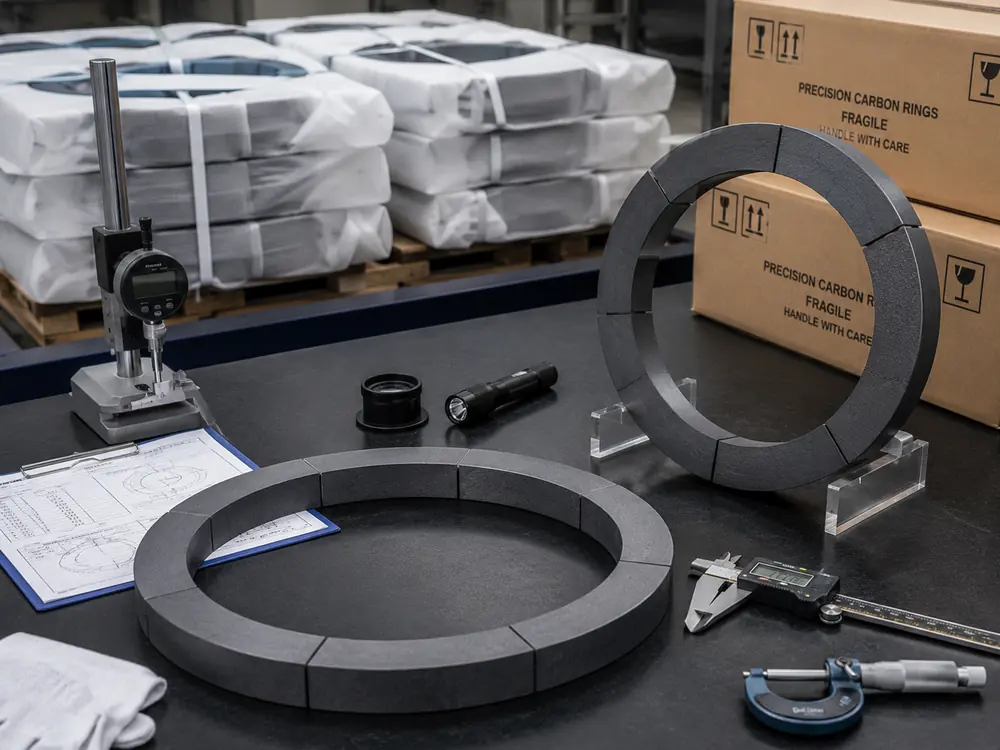
From Approved Drawing to Finished Carbon Component
CARBOLVE’s manufacturing workflow separates material approval from finished-component machining so that the drawing, material direction and inspection requirements remain connected throughout the project.
Technical Review
Confirm the seal type, component boundary, drawing, original material information and operating conditions.
Material & Drawing Approval
Establish the approved carbon grade, impregnation direction, dimensions, tolerances, working surfaces and functional features.
Precision Machining
Machine the finished carbon component by the required turning, milling, segment cutting, joint machining, groove or feature-machining operations.
Surface Finishing
Apply the specified working-surface finish or lapping only where the approved product and capability require it.
Inspection & Packing
Inspect the agreed dimensions and functional details, check visible edge and surface condition, and protect the sealing surfaces for shipment.

Metal-Impregnated Carbon Seal Buyer Guide
In This Guide
What are the main benefits of metal-impregnated carbon seals?
Filling part of a carbon material’s connected porosity with a compatible metal can reduce permeability and change stiffness, mechanical strength, heat transfer and wear behavior. These changes may make a verified grade useful for demanding sealing duties.
The benefit is not automatic or universal. It depends on the base carbon, impregnant, process medium, mating face, lubrication and seal design. A metal-impregnated grade should therefore be selected from complete application data rather than from the metal name alone.
How do metal-impregnated seals differ from standard carbon seals?
Unimpregnated carbon retains more of the base material’s open porosity. Resin or metal impregnation fills part of that structure and changes the material’s physical and tribological behavior.
Resin-impregnated carbon is commonly considered for general liquid sealing where the resin is compatible. Selected metal-impregnated grades may be evaluated for heavier loading, low-viscosity fluids, thermal demands or other specialized duties. Neither family is universally better.
What materials are used to impregnate carbon seals?
Common metal and alloy directions include antimony, copper, babbitt, bronze and nickel alloys. Antimony is frequently evaluated for demanding mechanical seal faces and low-viscosity-fluid duties. Copper may be considered where heat-transfer behavior is important. Babbitt, bronze and nickel-alloy directions serve more specialized lubrication, load, wear or chemical requirements.
The exact alloy, metal content and performance must come from an approved material specification. Appearance cannot identify the impregnation.
Which industries and equipment commonly use these seals?
Metal-impregnated carbon components may be used in industrial pumps, compressors, turbines, rotary joints, mixers, agitators and other rotating equipment. Typical component forms include rotary and stationary mechanical seal faces, solid carbon rings and segmented shaft-seal rings.
The equipment category alone is not enough to approve a grade. The medium, pressure, temperature, speed, lubrication, counterface and geometry still determine suitability.
How do metal-impregnated carbon seals compare with ceramic seals?
They normally perform different roles. Metal-impregnated carbon provides the softer, self-lubricating face, while silicon carbide, tungsten carbide or ceramic can provide the harder mating surface. A carbon–hard-face pair may offer a useful balance between conformability, lubrication and wear resistance.
Choosing one material in isolation can create an unsuitable face pair. Counterface hardness, finish, thermal behavior, fluid film, solids and seal loading should be reviewed as a system.
How should a buyer source seals for extreme temperatures?
First separate continuous temperature from short peaks, thermal cycling and start-stop conditions. Then identify whether the atmosphere is oxidizing or non-oxidizing and document the medium, pressure, speed, lubrication and counterface.
Ask the supplier for grade-specific data with units, test conditions and material status. Do not accept a single maximum-temperature figure as proof of suitability, and do not assume a metal grade is automatically better than a resin or all-carbon alternative.
How should manufacturers of metal-impregnated carbon seals be compared?
Compare what each supplier actually controls and documents:
- Whether it supplies raw mechanical carbon material, finished machined components or complete seal assemblies
- Whether the proposed material grade is released and supported by grade-specific data
- Whether the drawing, tolerances, surface requirements and functional geometry are controlled
- Whether media, pressure, temperature, speed, lubrication and counterface are reviewed
- Whether equivalent-grade claims are supported by more than density or hardness
- Whether inspection and packaging match the functional sealing surfaces
- Whether product scope, exclusions and inquiry requirements are stated clearly
CARBOLVE’s scope on this page is the application review and manufacture of finished carbon and carbon-graphite sealing components to an approved specification.
Discuss a Metal-Impregnated Carbon Seal Project
Send the information already available for your project. A drawing or existing grade is helpful, but the seal function and operating conditions are also needed before a material or replacement direction can be reviewed.
Useful information includes the seal type, drawing or sample reference, existing material code, OD, ID, thickness, process medium, normal and maximum temperature, pressure, RPM, lubrication condition, mating material, failure history and required quantity.